


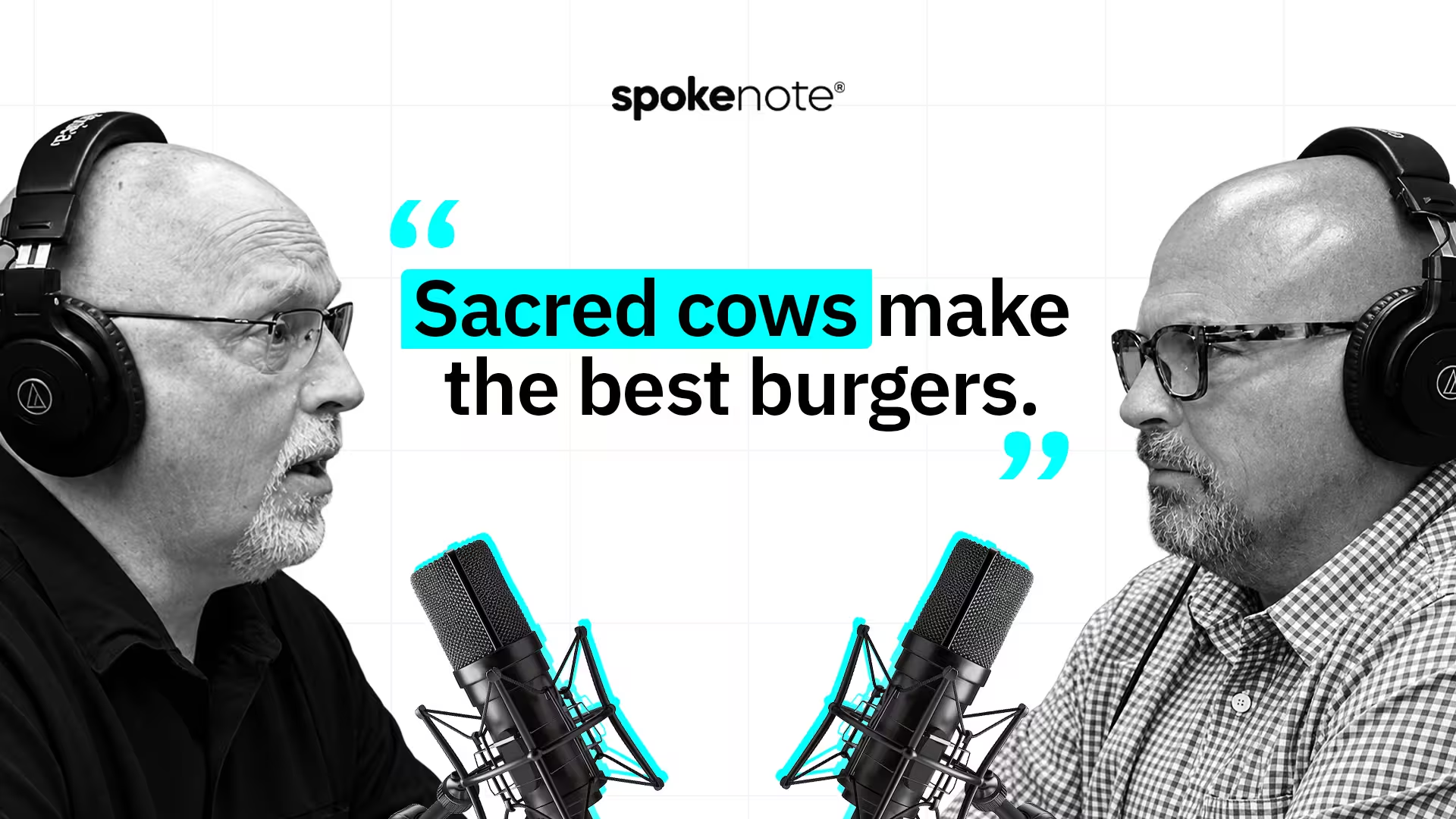
19 Oct “Sacred cows make the best burgers”: John Wechsler on the reality of innovation
Every business wants to innovate. The harder question is what happens when a new idea actually shows up.
Does the team explore it, test it, and give it room to develop? Or does the conversation quickly return to what already feels safe?
That tension was at the center of a recent Outside Perspectives conversation between host Mike Peck and Spokenote Founder and CEO John Wechsler. Across the conversation, Wechsler explored why organizations fall back on familiar approaches, how leaders can think differently about failure, and why some ideas are better shown than explained.
Innovation can come from anywhere. Does your team believe that?
Innovation often gets associated with founders, product teams, or the person with the biggest title in the room. Wechsler takes a broader view. It can show up in a process, a method, a product, or everyday life, and organizations can build a culture where more people feel able to contribute.
“Everybody on the team needs to feel like they are empowered to innovate,” Wechsler said.
That kind of culture also requires accepting that some experiments will go nowhere. When Peck raised the idea of “window time,” the chance to simply think and envision, Wechsler acknowledged that not every hour will produce something useful. That uncertainty is part of experimentation, and when every hour is expected to deliver an immediate result, new ideas have far less room to grow.
The fastest way to stall innovation? Make safety the default
Why do organizations struggle with innovation even when everyone agrees that innovation matters?
According to Wechsler, safety, security, and fear of failure all play a role.
Familiar approaches carry a certain comfort. They have been tested. People understand them. They may already be producing acceptable results.
That comfort can also make it easier to dismiss something new before giving it a real chance.
Wechsler recalled an old boss whose attitude toward outside ideas was simple: if the idea had not been invented there, he was not interested.
New ideas rarely arrive with years of proof attached. Someone has to be willing to explore them before they become familiar.
The challenge becomes even greater as organizations grow. Larger teams have established processes, performance expectations, existing technology, and more people affected by change.
Peck captured the issue with a simple observation during the conversation: “Just because it’s working doesn’t mean it’s delighting your customer.”
Something can function exactly as designed while still leaving room for a better experience.
That gap between functional and better is where innovation often begins.
Ask “why not?” and watch the conversation change
One of the strongest ideas from the episode comes down to two words: “Why not?”
Wechsler said organizations should be “asking why not way more than you ask why.”
The difference sounds small, but the starting point changes.
A conversation centered on “why” can quickly become a search for reasons to preserve the current approach. Why make the change? Why spend the resources? Why take the risk?
“Why not?” creates room to examine possibility:
- Could the process move faster?
- Could the customer experience improve?
- Could a team solve the same problem in a completely different way?
- Could a new technology open an option that did not exist when the current process was created?
Wechsler summed up his appetite for challenging established thinking with one of the most memorable lines from the episode: “sacred cows make the best burgers.”
The point goes beyond being disruptive for the sake of disruption. Markets keep changing, whether an individual business changes with them or not. Customer expectations move. Technology improves. Competitors experiment.
A process that worked yesterday can still deserve another look today.
Failure might be where the useful part starts
Innovation usually looks much cleaner in hindsight.
The finished product gets launched. The new process works. The successful company becomes a case study. All the abandoned versions, missed attempts, and wrong turns become much easier to forget.
Wechsler argues that leaders should pay closer attention to that messy middle.
His advice repeatedly returned to the role of failure and the importance of giving people permission to reach the edge of what works.
He compared it to pushing yourself in the gym. Growth requires enough effort to approach your limits. The same principle can apply when people are experimenting with an idea that has no guaranteed outcome.
Later in the conversation, he offered another way to think about setbacks: “Look at it as time-released success.”
To illustrate the point, Wechsler brought up WD-40 and the many iterations that came before the successful formula. The story works because the final result can make the earlier attempts look inevitable. They were still attempts. Someone had to continue testing.
That persistence matters inside organizations too.
A failed experiment can reveal what customers respond to, where a process breaks, which assumption was wrong, or what the next version needs to solve. The useful question is what the team learned and what it can try next.
Have an idea people struggle to understand? Show them!
The conversation gets especially interesting when Wechsler turns from innovation in general to the challenge of building Spokenote.
Spokenote’s original experience was relatively easy to explain. Scan a code, record a video, and share it with someone.
The company is now moving into software that can dynamically build video experiences based on personas or individual identities. That idea is harder to communicate because many people do not already have a familiar product category they can use as a reference.
Wechsler describes that territory as abstract and “blue ocean.”
So how do you explain something people have never experienced before? You show them.
“The way we break through that is by showing the product,” Wechsler said.
A few moments later, he made the idea even simpler: “Because when you see it, you know it.”
That may be one of the most useful lessons from the entire conversation.
Some ideas lose clarity when they are buried under explanations, terminology, diagrams, and feature lists. An experience can make the value obvious much faster.
Wechsler uses the Post-it Note as an example. Explaining the concept to someone who had never seen one could take longer than simply peeling one off and sticking it somewhere.
| Communication Approach | How It Works | The Audience Experience |
|---|---|---|
| Traditional pitching | Relying on heavy terminology, complex diagrams, and static feature lists. | The concept remains abstract and requires heavy mental effort to understand. |
| Physical demonstration | Showing the product in the real world, like sticking a Post-it Note on a wall. | The value becomes obvious immediately without the need for verbal persuasion. |
| Dynamic video | Using Spokenote to deliver personalized, visual proof directly to the viewer. | The idea becomes tangible, contextual, and instantly makes sense to that specific persona. |
The same principle applies when introducing a new product, pitching an unfamiliar approach, or communicating an idea that lacks an obvious comparison.
Show people what happens and give them something they can experience. Let the idea become tangible.
Showing beats telling, and Spokenote was built for that moment
That philosophy has a natural connection to Spokenote.
Organizations spend enormous amounts of time trying to explain ideas, outcomes, opportunities, and value through static communication. Sometimes the clearest message comes from seeing and hearing the person behind it.
Video adds context that a line of copy cannot always carry on its own. A face, a voice, an explanation, or a demonstration can make an unfamiliar idea easier to understand and a familiar message easier to remember.
Dynamic video takes that principle further by allowing organizations to create experiences that reflect different audiences, personas, and individual identities.
The technology may be sophisticated behind the scenes. The experience for the viewer should feel intuitive.
That is why demonstration matters so much for Spokenote itself.
Wechsler returned to the same idea throughout the conversation: Spokenote makes more sense when people can actually see the product in action.
For prospects, partners, customers, and teams exploring new ways to communicate, seeing the experience can answer questions that a product description may leave open.
The innovation question worth taking back to your team
Innovation can sound like a major strategic initiative. In practice, it often begins with much smaller decisions.
Will someone question the process everyone has grown used to? Will a leader give a new idea enough room to develop? And when an idea feels difficult to explain, will the organization keep describing it or find a way to let people experience it?
The conversation between Peck and Wechsler offers a useful reminder for leaders trying to keep their organizations moving. Innovation grows through repeated choices to explore, test, learn, and make new ideas easier for people to understand.
Sometimes the clearest way forward is simply to show what is possible.
Watch the full episode of Outside Perspectives featuring John Wechsler.
More conversations with John Wechsler
- Scaling Authenticity in Sales with John Wechsler on The Advanced Selling Podcast
- John Wechsler, CEO of Spokenote on Leaders and Legends
FAQs
Who is John Wechsler?
John Wechsler is the founder and CEO of Spokenote, a personalized video platform based in Fishers, Indiana. He is a serial entrepreneur who talks often about innovation, failure and making new ideas easier to understand.
What does “sacred cows make the best burgers” mean?
It means no process or habit should be off-limits just because it has always been done that way. Wechsler uses the line to encourage teams to question familiar approaches and ask “why not?” before defending the status quo.
How can leaders build a culture of innovation?
Give everyone on the team permission to suggest new ideas, not just founders or product teams. Make room for experiments that may not work, and treat failure as a source of lessons rather than a reason to stop trying.
Why is showing better than telling for new ideas?
Some ideas are hard to explain because people have nothing familiar to compare them to. A demonstration or video lets people experience the idea directly, so the value becomes clear much faster than through descriptions or feature lists.