



27 Nov Giving Tuesday: the second touch most organizations skip
Giving Tuesday ends, the receipts go out, and a thank-you email follows within a day or two. On a busy year-end calendar, the next message a Giving Tuesday donor gets is often the year-end appeal.
This post is a plan for the message in between, which we call the second touch: a short note from a real person that shows a donor what their gift did and asks for nothing. It is written for nonprofit development directors and executive directors, and it can be planned now, ahead of Giving Tuesday on December 1.
What the first touch can and cannot do
The first touch is the receipt and the thank-you. It tells the donor the gift arrived and that someone is grateful. What the gift did comes later, so the first touch has nothing to show yet.
That gap is the second touch. It comes from a person close to the work, it shows one thing the gift made possible, and it leaves out the ask. It is where a donor starts to feel known, because it is the first message about what their gift did.
Why the second touch is worth planning
GivingTuesday estimates that people in the US gave $4.0 billion on GivingTuesday 2025 and that 19.1 million of them made financial contributions, according to its 2025 results. These are Data Commons estimates for the US. They cover gifts to any recipient and count the day’s total, so they say nothing about any one organization’s donors.
In October 2025, Blackbaud Institute and GivingTuesday reported that 65% of donors who gave on GivingTuesday in 2024 gave again in 2025, against 52% of all donors. Blackbaud sells fundraising software, and the figure comes from its own dataset. The release does not define repeat giving or describe the sample, and the two groups may differ in ways unrelated to the day itself. Read it as a description of who these donors are. It does not say why they gave again.
Penelope Burk’s donor research, summarized in a Nonprofit Quarterly column, found that 93% of donors surveyed said they would definitely or probably give again to a charity that thanked them promptly and personally and later reported on the program their gift funded. The column dates from 2009 and gives no survey year or sample size, and the figure measures what donors said they would do, which may differ from what they did. It does describe the shape of the second touch; a prompt thank-you, then a report on what the gift funded. Our post on donor stewardship covers the thank-you in the first 48 hours. This post picks up after it.
Decide what you can truthfully show before December 1
The second touch only works if what it shows is true. Giving Tuesday gifts often go into a pool, so start by asking what that pool will fund and when. Then ask what you could show a donor by mid-December: a number from the work, or a photo with a line from the person who did it. A food pantry might show meals packed, and a tutoring program might show sessions held.
Match the proof to the timing. If the work finishes in March, you can say what the gifts are paying for now and when you will report next. Do not estimate what one gift did unless you have a basis for the number, and do not call a matched gift doubled unless the match closed. If you cannot show results yet, say what is under way, name the date you will write again, and write on that date.
Who the second touch should come from
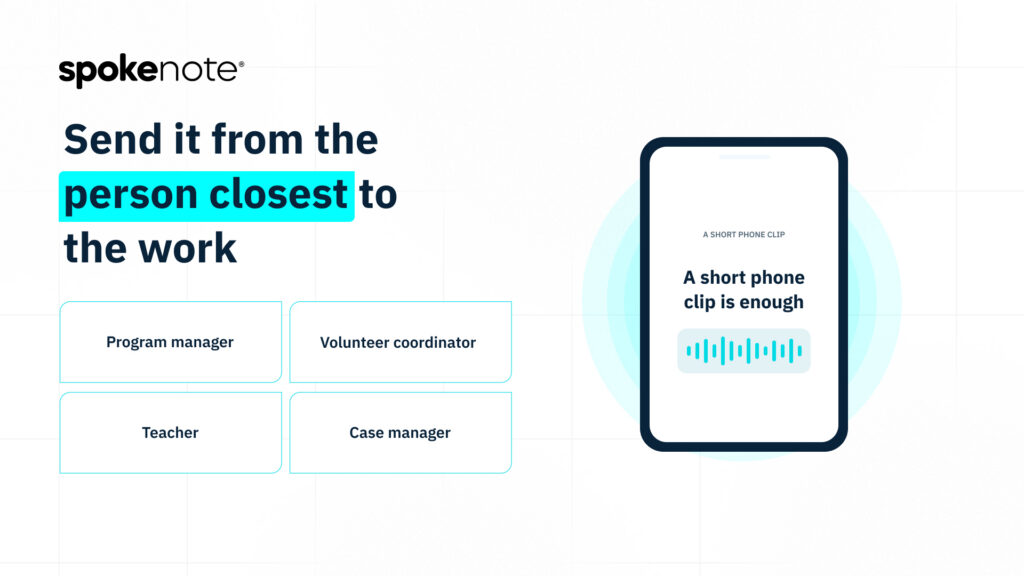
The best sender is a person who can describe the work in their own words, such as the program manager, the volunteer coordinator, a teacher or a case manager. The development director can send it, and a line from the person closest to the work is what tells the donor the gift went somewhere.
If you use video, a short clip recorded on a phone is enough. Our post on who should be on camera covers how to choose. A short clip or note from a named person does not change your open rates, deliverability or list quality, so the second touch still depends on a clean donor list and an email setup that reaches the inbox.
Sample lines for the second touch
Each sample comes from a named role and shows one thing. The details in brackets are placeholders, so use only what is true for your organization.
A first-time Giving Tuesday donor
Hi Maria, this is Kevin, the program manager. You gave on Giving Tuesday, and I wanted you to see where it went. The gifts from that day paid for [number] [what it bought] at [program]. Here is a photo from [session or day]. You don’t need to reply, but if you have a question about the program, write to me at this address.
Kevin, Program Manager
A returning donor
Hi James, thank you for giving again on Giving Tuesday. Your earlier gifts helped [program] [what happened]. This year’s gifts are going to [use], and I’ll write in [month] to show you how it is going.
Elena, Development Director
A donor who gave to a named program
Hi Ruth, you gave to the tutoring program on Giving Tuesday. I’m Grace, and I coordinate the tutors. Because of the gifts that day, [number] students have a tutor through spring. One of our tutors recorded a short hello for you: [link].
Grace, Volunteer Coordinator
A donor whose gift was matched
Hi Ahmed, your Giving Tuesday gift was matched, so the total that went to [program] was [amount]. Here is what it paid for: [specific item]. Thank you for being part of it.
Daniel, Executive Director
Use that note only if the match is closed and the numbers are final.
When the work has not happened yet
Hi Maria, the gifts from Giving Tuesday are set aside for [program], which starts in [month]. I’ll send you a photo from the first week.
Kevin, Program Manager
Then send the photo.
When it goes out
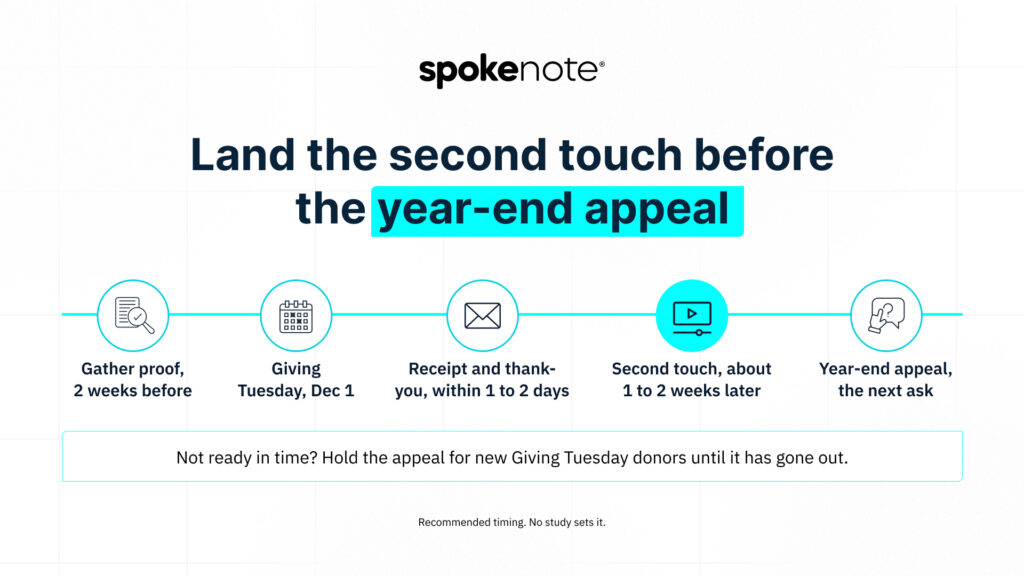
No study sets this timing, so treat it as a recommendation. Gather your proof in the two weeks before Giving Tuesday. Send the receipt and a short thank-you within a day or two of the gift, which our posts on [link: What should a donor thank-you video say?] and [link: After the event: how to follow up with every guest within 48 hours.] cover. Send the second touch about one to two weeks later, early enough to land before the year-end appeal.
If the second touch cannot be ready before the appeal, hold the appeal for new Giving Tuesday donors until it has gone out. Otherwise, the donor hears the next ask before hearing what the last gift did.
What to leave out
Leave out the ask, which rules out a donate button and a match countdown. Survey links can wait too. A reply address is enough. The year-end appeal can carry the ask, and it reads differently once a donor has seen what the last gift did.
How to tell whether it worked
Count replies first, because a reply to a note like this tells you what they care about. Then watch how second-touch recipients respond to the year-end appeal compared with last year’s Giving Tuesday donors who got only the thank-you. Describe any difference as associated with the second touch, since the size of the gift and the donor’s history also move giving. Our guide to measuring video outreach performance covers tracking signals beyond views if you send video.
Frequently Asked Questions
What is a second touch after Giving Tuesday, and how is it different from a thank-you?
It is a short message from a real person, sent after the first thank-you, that shows a donor what their gift did. The thank-you confirms the gift arrived. The second touch shows what the gift did, and it asks for nothing.
How soon after Giving Tuesday should the second touch go out?
About one to two weeks after the gift, and ahead of the year-end appeal. That timing is our recommendation, and no study sets it.
What if we cannot show results yet?
Say what is under way, give the date you will write again, and write on that date. A truthful note about work in progress is better than a number you cannot support.
Should the second touch include a donation link?
No. Keep the ask for the year-end appeal. A reply address is enough.
Who should send the second touch?
The person closest to the work, such as a program manager or volunteer coordinator, with the development director or executive director as sender or signer where that fits. Avoid a general info address.
Do small Giving Tuesday donors need a second touch?
Yes, and the same message can go to the whole group. A note that shows what the day’s gifts paid for works for every donor in it, with a line from the person who did the work.