


03 Mar Coherent Video Strategy: The “Fresh Eyes” Approach to Scaling Trust
Key Takeaways:
- The Personalization Shift: Passive personalization (like a merge-field first name) is no longer enough; active personalization requires adapting the actual story to the viewer’s context.
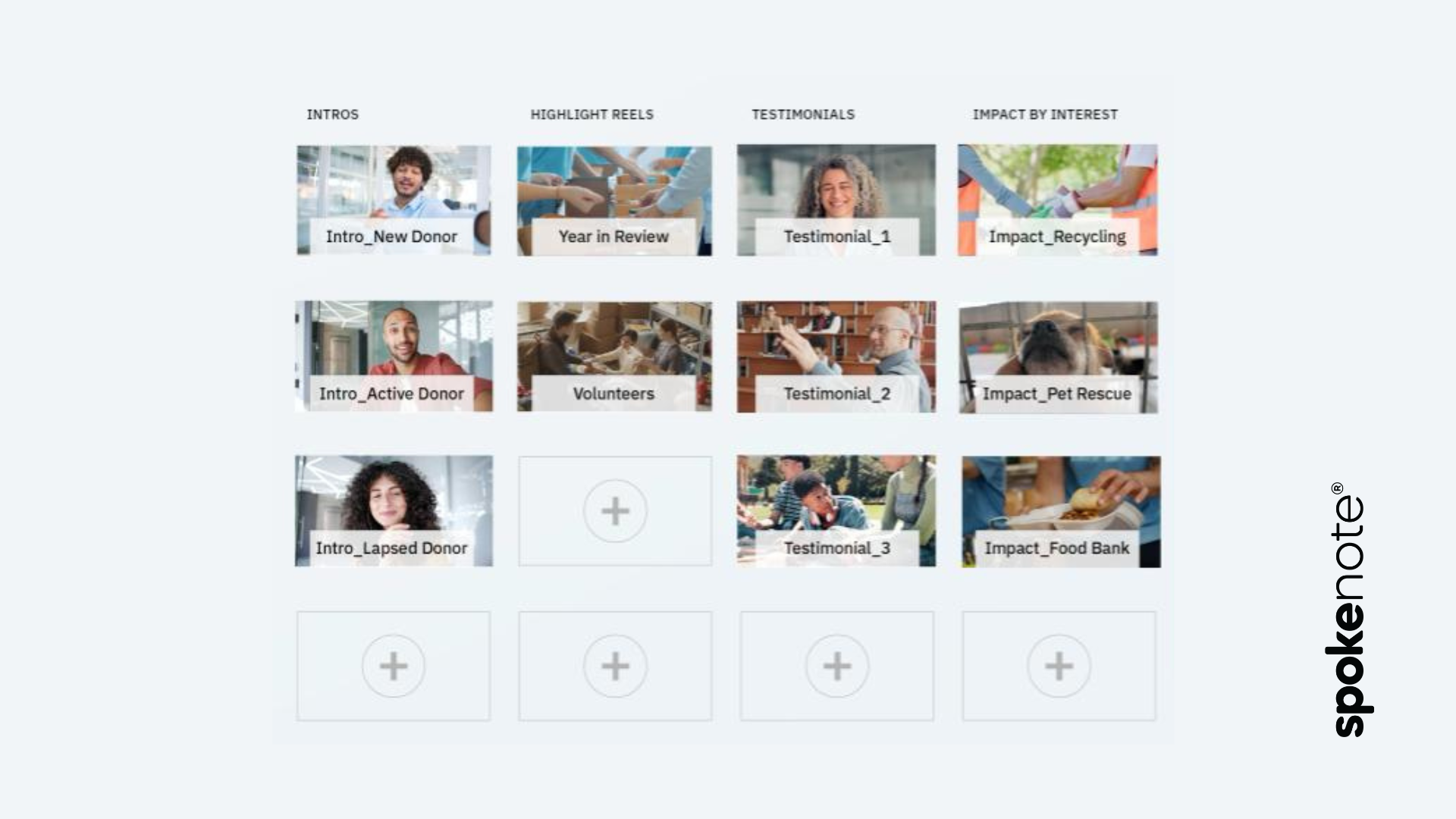
- The “Movable Type” of Video: Stop producing monolithic, one-size-fits-all videos. Treat your existing video assets as modular components that can be dynamically assembled.
- The Power of Lo-Fi: Polished, high-production videos are losing ground. Authentic, unscripted “lo-fi” content generates 40% more views and outperforms studio-shot content 84% of the time.
- The “Symphony of Voices”: A coherent strategy relies on modular storytelling – an invitation, a context-specific reality, social proof, and a clear call to action – delivered by real human faces.
In our first deep dive into the keys to success with dynamic video, we explored how audience segmentation helps move organizations from “passive personalization” (dropping a name into a generic email) to “active moments” where the content adapts to the context. But once you know who you’re speaking to, the next challenge often feels overwhelming: What are we actually going to say? Or worse – where is all that content?
This brings us to our second key: Coherent Video Strategy.
Too often, organizations suffer from “production paralysis”. They believe that to launch a video strategy, they need a six-figure budget, a full camera crew, and months of editing – and don’t forget the sweeping drone shot set to some half-hearted attempt at upbeat acoustic guitar. Bonus points for lens flare. We encourage teams to reject this “one-size-fits-all” monolithic production model and instead adopt a “Fresh Eyes” approach.
Here is how you can scale trust, leverage your existing assets, and build a video strategy that actually connects in 2026.
1. The Content Goldmine: You (Probably) Already Have What You Need
The biggest lie in video marketing is that you need to start from scratch. Most organizations are “Content Rich but Connection Poor”. You likely have a goldmine of assets – testimonials, event footage, founder messages, or beneficiary impact stories – scattered across YouTube, social feeds, or the digital graveyard of some forgotten Google drive. Or on that guy’s old computer that no one has the password for, nevermind possessing any desire to search through that…nightmare.
A coherent strategy begins by looking at this library objectively. These existing pieces are your “movable type”.
Before Johannes Gutenberg, printing was a monolithic process – you carved one giant block to produce the exact same message for everyone. Traditional corporate video operates the exact same way today: you produce one highly-polished video, blast it to your entire database, and hope someone watches.
When you start treating your existing video library as interchangeable modules rather than finished films, they become the building blocks for thousands of personalized experiences. Data determines what gets assembled, context determines the sequence, relevance determines the outcome. Now you’re not producing one video for everyone, you’re assembling video for an audience of one.
2. Modular Construction: Building the “Symphony of Voices Faces”
Instead of chasing one “perfect” five-minute corporate video, a coherent strategy focuses on modular construction. This framework allows you to assemble a unique video for each viewer on the fly, based on their specific needs and data.
A successful dynamic video experience typically follows this modular flow:
- The Invitation: A human-recorded, “Lo-Fi” intro that establishes an immediate connection. The human brain is wired to prioritize faces; when a viewer sees a face, the Fusiform Face Area processes it in milliseconds, instantly establishing authenticity and bypassing analytical skepticism.
- The Reality: A segment specific to the viewer’s interest. For higher education, this might be a segment specific to an admitted student’s intended major. For a nonprofit, this is the “Intervention” stage, showing a mission-specific update that directly aligns with the donor’s past giving history, ideally featuring a sole beneficiary sharing their story and the impact the nonprofit mission has made on their life.
- The Social Proof: A testimonial or “closer” from a peer, survivor, alum, or supporter that validates the message and reinforces credibility. Research shows that focusing on a single, identifiable individual prevents “compassion fade” – the psychological phenomenon where human empathy actually decreases as the number of people in need increases.
- The Close: A clear Call to Action (CTA) that drives the next step, ensuring the emotional momentum is channeled into measurable action.
Beyond the psychological benefits, this short-form approach is operationally superior, not just trendy. Because you are building modularly, you face a much lower production barrier. It becomes incredibly easy to swap out segments for different cohorts, drastically reducing internal resistance and workload.
3. Perfection is the Enemy of Authenticity (The Lo-Fi Advantage)
In an era of deepfakes, AI avatars, and synthetic voices, we’ve entered the uncanny valley of marketing. High-gloss production increasingly triggers suspicion rather than trust. Audiences are suffering from perfection fatigue; when everything looks perfectly engineered, they assume they are being manipulated – or worse, marketed to. Nobody relates to a perfectly lit CEO reading a teleprompter without blinking.
Say it with me, again: do not overproduce these modules. Industry research and platform data consistently show that “Lo-Fi” content – raw, unscripted, smartphone-shot video with natural lighting and ambient sound – substantially outperforms professional sizzle reels.
Consider the data:
- Lo-fi videos generate 40% higher view rates and 30% greater reach than polished, high-fidelity content.
- Self-recorded videos outperform studio-shot content 84% of the time on platforms like Facebook.
- Lo-fi content generates nearly 2x the engagement rates of its polished counterparts 6.
This should feel like creative liberation for your team. You can stop saying, “We don’t look good on camera,” “we don’t have a studio,” or “we don’t have videographers.” People don’t want actors, they want humans! They don’t want a performance, they want presence! Your audience isn’t grading your production; they’re scanning for sincerity.
But let’s be clear: authenticity is not sloppy; it’s intentional humanity. It’s about achieving coherence in the audience’s moment, the messenger, and the message. It’s about redefining “AI” to mean Authentic Interactions. Flaws function as proof of humanity. A slightly shaky camera or an unscripted pause reminds audiences that there is a real person behind the brand. When a university welcomes a student with a video from a student they can relate to, or a nonprofit shares an unedited “day-in-the-life” clip of their volunteers, it signals safety and sincerity.
To break through the soulless noise of modern automation, you don’t need more production value; you need more presence.
The Bottom Line: Connection with Operational Leverage
A coherent video strategy isn’t focused solely on creating more content – it’s about creating more connection with operational leverage. By treating video as “movable type,” adopting modular storytelling, and prioritizing human presence over production perfection, you turn cold data into genuine relationships.
The personalization illusion is over. When the content adapts to the context, trust increases. You stop fighting for expensive attention and start earning priceless engagement.
Ready to see how your existing content can drive real results? The third and final key to success is Workflow Support, where we’ll tackle the #1 fear of ambitious marketing and development teams: “How much more work is this going to create for my team of one? And our part-time intern? Who could forget the intern…”