


20 Mar What We Heard at NTC 2026 (And What It Confirmed About Donor Connection)
Some conferences validate what you already suspected. NTC 2026 in Detroit was that kind of week.
Our team came in with a hypothesis: nonprofits aren’t struggling because they lack content or data, but because something’s missing in how that content reaches the people who care most. What we found, session after session and in hallway conversations, was a sector asking exactly that question. Not “how do we get more data?” but “why isn’t the data we already have working?”
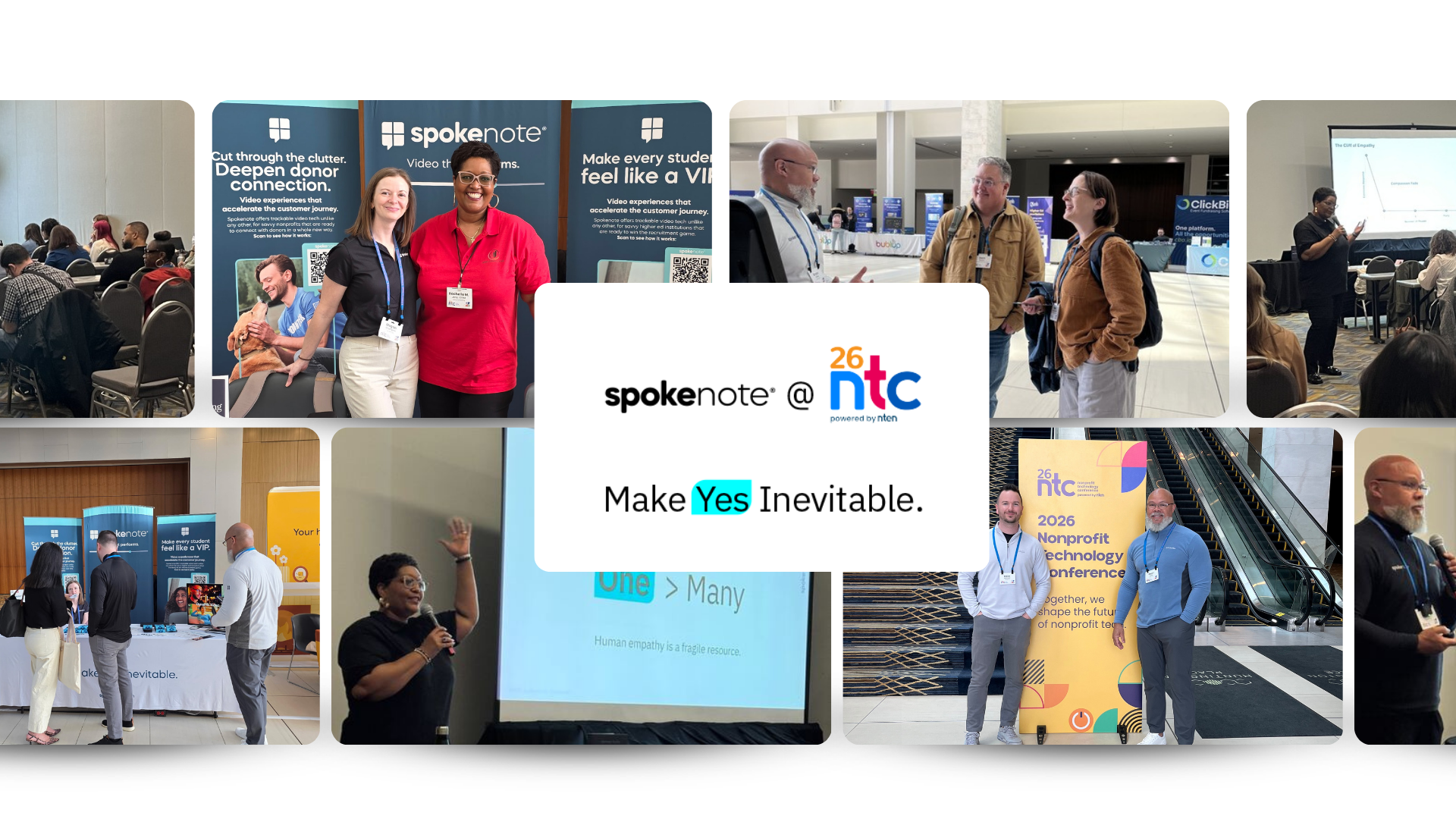
For context: we were there with a session of our own. “Make Yes Inevitable” was led by Bryan Kelley, Spokenote’s Head of Enterprise Solutions, alongside Rochelle Jerry, CEO of Jerry Consulting. Rochelle is adjunct faculty at the IU Lilly Family School of Philanthropy’s Fund Raising School, a contributor to Nonprofit Quarterly’s “Ask an Expert” column, and a Global Board Member of the Association of Fundraising Professionals, and one of the sharper fundraising minds working in this sector. But before we get to that, here’s what we heard in the rooms we were in.
The Room Was Full. And So Were the To-Do Lists
If you work in nonprofit communications, you already know what the temperature felt like.
Teams are doing more with the same, or fewer, resources. The channel list has grown: email, social, text/SMS, video, direct mail, events, peer-to-peer. Each one requires a different tool, a different voice, a different workflow. According to NTEN’s research, small nonprofits typically have one or two people managing all of it. Mid-size organizations rarely have a dedicated digital role.
This isn’t a complaint. It’s a structural reality the sector keeps bumping into. The people we talked to weren’t burned out on mission. They were stretched by expectation. There’s a quiet exhaustion that comes from knowing what good looks like and not having the runway to get there.
What struck us wasn’t despair, though. It was a kind of practical hunger. Yes, this was a nonprofit technology conference, but people weren’t looking for more technology. They were asking for clearer answers about which technology actually closes the gap between what they’re doing and what they (and their donors) want to feel.
Data Is Everywhere. Connection Still Feels Hard.
Here’s the paradox sitting at the center of most nonprofit communications right now: organizations have never been more data-rich, and donors have never felt harder to reach.
The dashboards work. The KPIs are tracked. The impact reports go out. And donor retention rates have still hovered around 42-45% for years, meaning most organizations are quietly losing more donors than they keep. New donor retention is even more stark, somewhere around 19-23%. About four out of five first-time donors never give again.
That kind of data reveals a problem rooted in connection.
The research is clear, and it’s something our session addressed directly. A landmark study by Västfjäll, Slovic, Mayorga, and Peters, published in PLOS ONE, found that our capacity to feel compassion is not just limited, it starts to fade as soon as you introduce a second person in need. They called it “compassion fade.”
In one experiment, participants were given the chance to donate to either a single identified child or two identified children. The single-child condition raised significantly more: 37.7 Swedish crowns on average versus 26.3 for the two-child condition. The difference wasn’t driven by logic or perceived impact, it was driven by affect. When the researchers controlled for emotional response, the gap in giving disappeared entirely. Feeling, not reasoning, was doing the work.
This isn’t apathy. It’s a real, measurable psychological response: as the number of people in need grows, positive emotional engagement decreases, and so does giving. Our brains treat a single identified person as a coherent, real individual, they get full attention, full empathy, full response. Groups get processed more abstractly, the emotional signal weakens, and donations follow.
The implication for nonprofits is direct: your impact data, however accurate, may be working against you when it leads the conversation. Not because the numbers aren’t real, but because numbers don’t activate the part of the brain that makes people give.
What does? A face. A voice. A specific person in a specific moment.
Make Yes Inevitable: What Bryan and Rochelle Brought to the Session
This was the frame for our session: the science of why some communications move people and others don’t, and what nonprofits can actually do about it.
The Science Behind Why One Face Beats a Thousand Statistics
Researcher Paul Zak at Claremont Graduate University spent years studying the neurochemistry of trust and generosity. His finding: narratives that follow a tension arc, a real person facing a real challenge, working through it, trigger the release of oxytocin, which is directly linked to trust and giving behavior. We give because we feel something, and we feel something because a specific human made us feel it.
The face and voice combination matters in ways text can’t replicate. Voice carries emotional texture – warmth, urgency, specificity – that signals to a listener something is real. When donors see a face and hear a voice, they activate the same neural pathways that process in-person connection.
Rochelle was direct about it in the session: donors don’t make decisions based on numbers alone. They make them based on whether they trust you. And trust is built through biological signals that data can’t send.
What Scaling Human Connection Actually Looks Like
The challenge nonprofits face isn’t that they lack good stories or credible people. It’s that getting a face and a voice in front of every meaningful donor, at every meaningful moment in the relationship, feels impossible at scale.
That’s exactly the problem Bryan Kelley works on every day with fund development teams and higher education advancement offices. His argument, and the one the session made with evidence, is that scale doesn’t have to mean losing the human signal. Dynamic video and active personalization can deliver the biological markers of trust, a real person, speaking directly, to you, at a volume that would be impossible through traditional one-to-one outreach.
The takeaway isn’t “use more video.” It’s this: audit your donor communications and ask honestly whether they’re activating trust or defaulting to data. Most organizations already know the answer.
AI Came Up, But Trust Came Up More
You can’t spend a week at NTC without talking about AI. And the conversation in 2026 is noticeably more grounded than it was a year ago. Less hype, more honest questions.
What we heard: organizations are curious. Most are cautious. And the data backs that up. A 2024 donor perceptions of AI study surveyed 1,006 active donors on their perceptions of AI in the charitable sector. The findings are worth sitting with: 60% of donors cited lack of human touch as a top concern, essentially tied with data privacy. And 31.4% said AI use would make them less likely to donate. Not indifferent. Less likely.
Donors are broadly comfortable with AI in the back office – fraud detection, operational efficiency, drafting. But when it comes to the relationship itself, the concern is consistent and clear: automate the ask, and you may lose the donor.
The hesitation isn’t primarily about cost or technical complexity, though those are real. It’s about trust. The question underneath most AI conversations in the sector is: if we automate this, does it feel automated?
That’s the right question. The risk isn’t AI itself, it’s AI used to replace the human signal instead of expand it. If an organization uses AI to send faster, cheaper mass communications, and those communications feel like mass communications, they’ve solved the wrong problem. Donors already have more content than they can process. What they’re short on is a reason to feel like someone actually meant to reach them specifically.
The opportunity is using AI to make human communication possible at greater scale. Not to automate away the face and voice, but to help teams get their people in front of more donors, more consistently, than they could on their own.
What We’re Taking Back to the Work
Here’s what we keep coming back to after a week in Detroit.
The organizations doing this best aren’t the ones with the biggest budgets or the most sophisticated technology. They’re the ones that found a way to put a real person in front of donors at the moments that matter. A thank-you that comes from someone’s actual face, not a template. An update that references what this donor specifically did. An ask that feels like a conversation, not a broadcast.
According to the Fundraising Effectiveness Project, recurring donor retention sits below 44%%. First-time donor retention sits below 25%. That gap isn’t a mystery — it’s a relationship problem. Monthly donors feel connected to the organizations they give to. First-time donors often don’t. The question isn’t how to get more first-time donors. It’s how to build connection early enough that a second gift feels obvious.
The content to do that already exists in most organizations. The stories are there. The people who care are there. The data is there. What’s often missing is the mechanism to get a real face and a real voice in front of the right donor at the right moment.
That’s the work. NTC confirmed it. And we’re glad to be part of organizations figuring it out.