


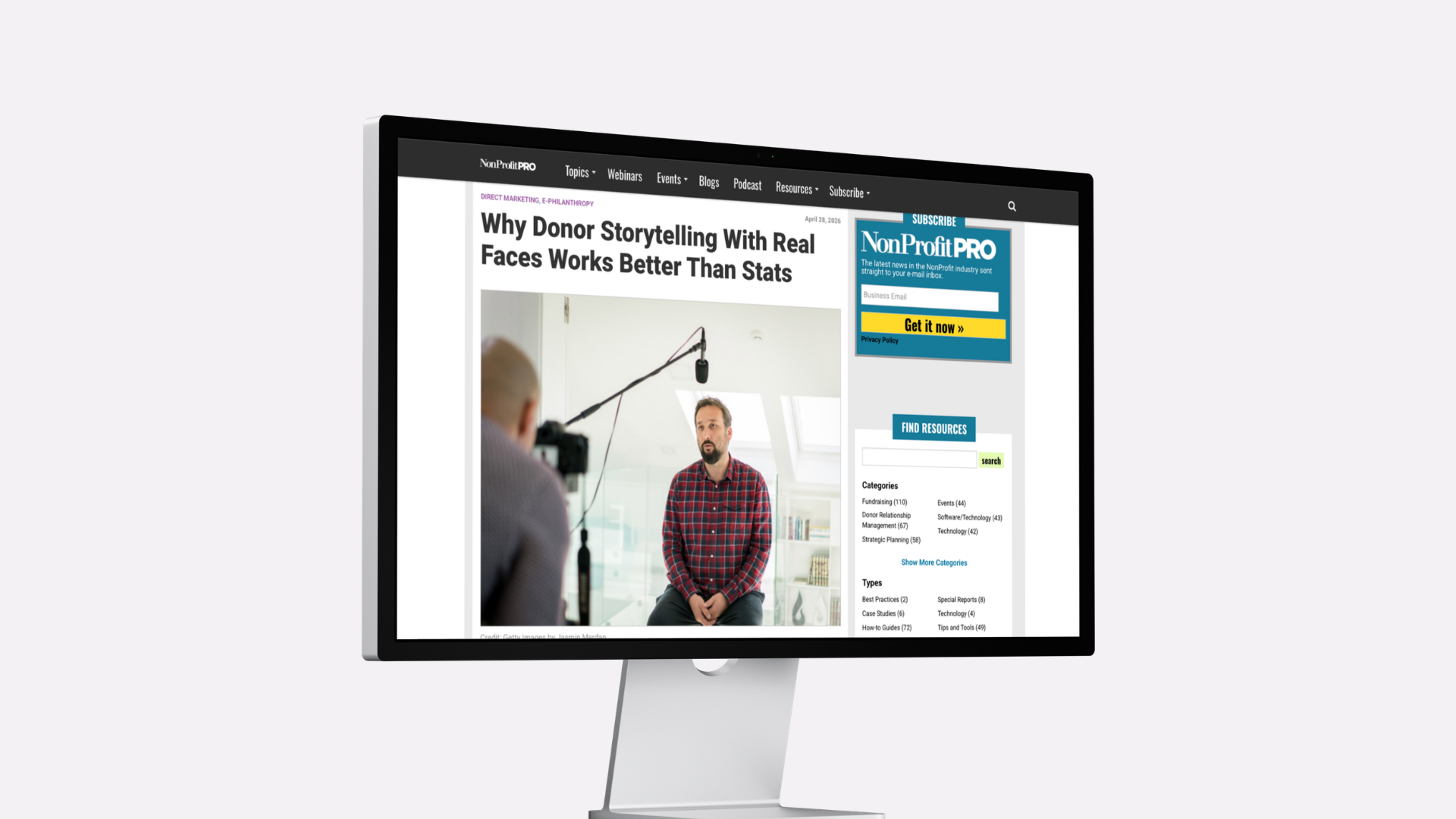
06 May Why Donor Storytelling With Real Faces Works Better Than Stats
Originally published by Nonprofit PRO.
There’s a moment most nonprofit leaders recognize immediately. You spend weeks building something thoughtful – gathering outcomes, verifying numbers, and refining language so it reflects your mission with integrity. You send it out, and then… it just floats. A few opens, a handful of polite clicks, but the real response – the “I’m in” – never arrives.
If that experience feels familiar, it’s not because your organization is doing something wrong. It’s because today’s world is saturated with digital communication – emails, ads, and AI-generated content – that often lacks a soul. In this environment, sending information is no longer enough; it has become what donors experience as invisible noise. When everything is optimized for efficiency, meaning is often the first casualty.
Attention has become fragmented, but more importantly, trust has become fragile. When every inbox is crowded and every platform is optimized for output, even well-intentioned messages can blur together and lose emotional clarity.
Nonprofits are often told that donors are rational and want data-driven proof. But in practice, numbers rarely create the emotional connection that moves someone from passive supporter to active involvement. Data may justify a decision, but it rarely initiates one.
Biology explains why. Human beings are susceptible to a cognitive glitch called “compassion fade.” Our psychological ability to feel empathy does not scale linearly; it actually decreases as the number of people in need increases. While numbers demonstrate efficiency and stewardship for a board, they require the brain to engage in slow, energy-consuming calculation. To the donor’s heart, a million is a statistic; a single person is a reality. As scale increases, emotional proximity decreases. The brain protects itself by disengaging, not out of indifference, but out of overload.
Our brains evolved to read people quickly. When a donor sees a face, a specific region – the Fusiform Face Area – processes that expression in milliseconds. This isn’t just information; it’s a biological signal that says, “This is real. This is someone.” That signal establishes authenticity instantly. It bypasses analysis and creates a felt sense of credibility that written claims struggle to achieve on their own.
A face invites empathy in a way abstract charts cannot. Psychologists call this the Identifiable Individual Effect: the brain is wired to prioritize the one over the many. It’s why one story of a single student or survivor consistently outperforms a hundred data points. A person has a name and a voice – things the brain can hold.
To fight this “invisible noise,” many organizations have turned to “passive personalization” – using data to drop a donor’s name into a template. However, research suggests this can backfire. Passive personalization can actually generate negative experiences for 53% of customers, making them 3.2x more likely to regret their decision to engage at all. When personalization is purely mechanical, donors sense the disconnect. Instead of feeling seen, they feel processed, and that subtle shift undermines trust.
The breakthrough for 2026 is active personalization: replacing automation with authentic interactions. When donors engage with content that feels human and sincere, they are 2.3x more likely to move forward with confidence. Active personalization doesn’t amplify pressure; it reinforces assurance. It shifts communication from persuasion to affirmation, allowing donors to feel grounded in their decision rather than pushed toward one.
The organizations that will win in the next decade are those that move from “one-size-fits-all” production to a modular video workflow. By interweaving different perspectives, you can scale human connection without losing sincerity. This framework creates a “bridge of trust” through a series of authentic moments, beginning with The Invitation: A human-recorded “intro” that establishes a personal connection.Once this connection is in place, the next moment is The Reality: A survivor or beneficiary perspective that makes the mission tangible. The final moment is, The Social Proof: A benefactor or volunteer sharing why the mission merits their “time, talent, or treasure.”
Each moment builds on the last, gradually replacing distance with familiarity. Rather than asking donors to imagine impact, you allow them to witness it through real human presence. Numbers build credibility, but trust is what converts and retains. Before your next appeal or impact update, ask yourself: Where is the face?
If there is no face, the donor may never feel the story. And if they never feel it, they may never move. But if you can give them one real person – one voice, one moment, one clear invitation – and thoughtfully weave additional authentic perspectives around that voice, you are no longer asking them to understand the mission or process a statistic.
You are giving them a way to belong to it.
John Wechsler is the founder of Spokenote and a seasoned entrepreneur with over 30 years of experience building and investing in high-impact organizations. He is passionate about using emerging media and technology to solve real-world problems. At Spokenote, John leads the vision to make communication more personal and engaging through simple, scalable video experiences.