


05 Nov What counts as personal in admissions outreach
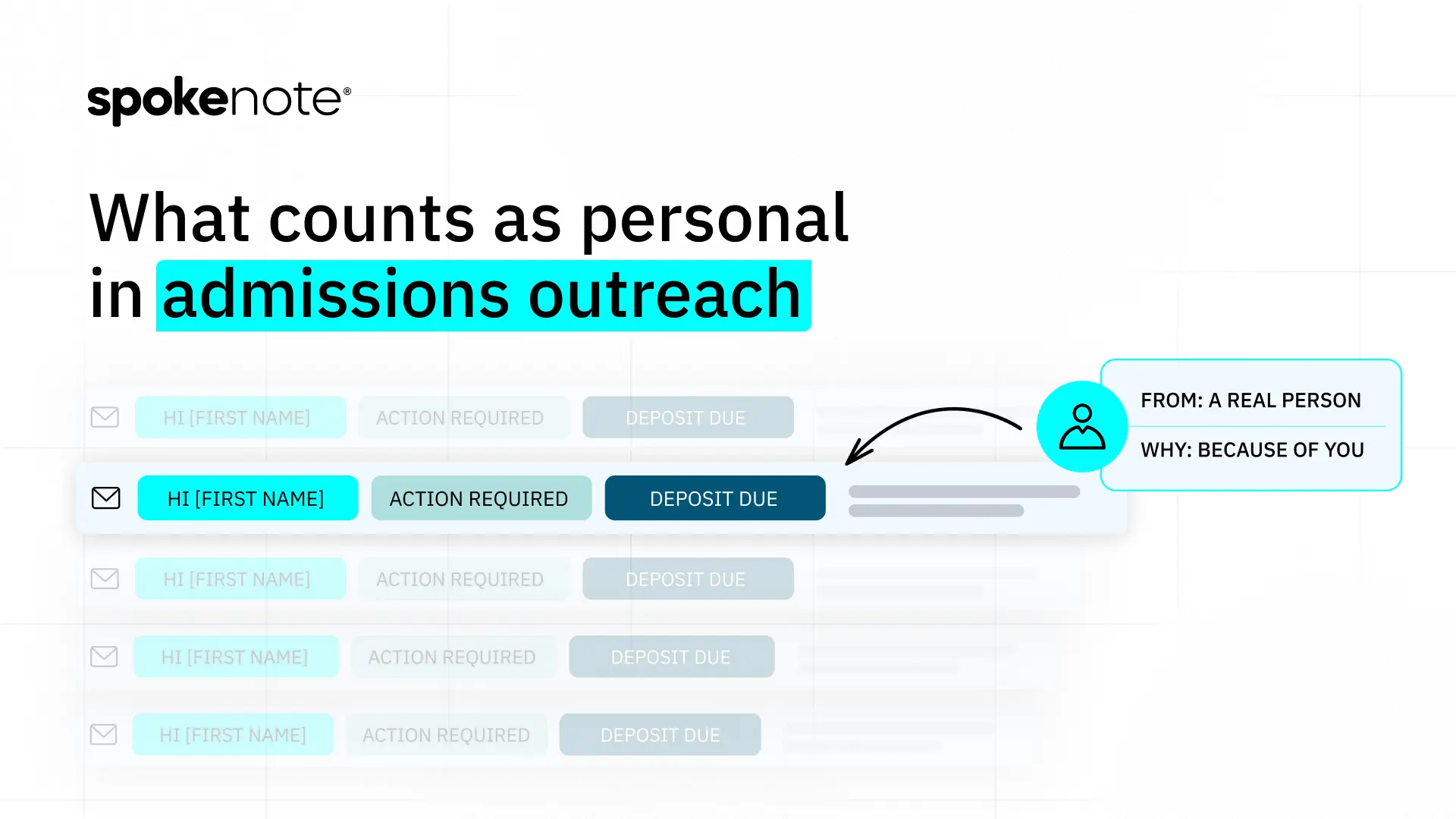
A message counts as personal when the student can tell a real person sent it and why it was sent to them. A first name dropped into a template rarely clears that bar on its own.
That is the short answer. The longer one is worth a few minutes, because the test for “personal” is simple enough to run on any message before it goes out.
The two-question test
Before a message reaches an admitted student, read it the way they will and ask two questions.
Can the student tell who sent it?
The answer the student needs is a person’s name. A message signed “The Office of Admissions” tells the student that an institution noticed them, but a message from a professor in their program, or from the counselor who read their application, tells them who noticed them. The second gives the student a name to remember and someone they can reply to.
Can the student tell why it was sent to them?
A message passes the second half of the test when it shows the sender knows something about this student in particular: the program they chose, the question they asked at a visit, the reason they applied. If the same message could have gone to every admit on the list with only the name changed, the student may recognize the template anyway.
Many students already feel that way about what colleges send them. In Niche’s 2024 Spring Junior Survey, only 15% of high school juniors said colleges were sending them information that was very relevant to their interests.
A message that clears both questions feels personal even when it is short. A message that fails either one rarely feels personal, however warm the wording.
What the test looks like on a real message
Here is a message that fails both questions:
Hi Maya, congratulations on your admission! We can’t wait to see you on campus. Don’t forget to submit your deposit by May 1.
The Office of Admissions
And here is one that passes:
Hi Maya, I teach the first-year design course in mechanical engineering. Your application mentioned the robot you built for your science fair, and that is exactly the kind of project our students start with in the fall. If you have questions about the program, reply here and it comes straight to me.
Dr. Sam Lee, Mechanical Engineering
The second message is barely longer. The difference is that Maya can see who wrote it and why it was written to her.
Where a first name falls short
Adding a first name to a template was a reasonable step when most outreach had none. Today it is so common that many students hear it as little more than “your name here.”
That is where the cost comes in. When a family can see the template behind the warm opening, the message meant to build trust can quietly do the opposite. An admit who notices the automation may trust the school less than if it had simply sent a plain, honest note. For a mid-size school, where the enrollment fight is tightest, that is a cost worth avoiding.
Students are already watching for this. In ZeeMee’s Student Pulse Survey of nearly 8,000 college-bound students, run in August 2026, 57.9% said they believe a college has already sent them an AI-written message. Thirty-five percent said they would think less of a college that used AI to write its emails or texts, and another 35% said it would depend on whether the college was upfront about it.
When the only message is a request

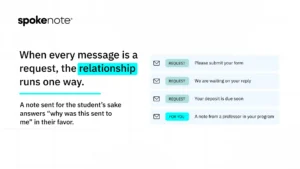
There is a second way outreach fails the “why” question, and it has nothing to do with templates. Look at the messages an admitted student receives over a few weeks and sort them by purpose. If almost every message arrives because the school needs something, such as a form, a reply, or a deposit, the pattern is easy to read from the student’s side. The only time they hear from the school is when it wants something. Each message might be polite and well written, and the student still learns that the relationship runs one way.
A message sent for the student’s sake reads differently. A note from a faculty member about the program they were admitted to, or a word from a current student about their first semester, gives the admit something without asking for anything back. Those messages give the student a better answer to the question, “Why was this sent to me?”
Who the message should come from
The person with the relationship is usually the right sender, and it rarely needs to be the president. A simple standard helps: every admitted student hears from a person tied to the institution, not only from the enrollment inbox.
This matters most for the admits who get the least attention. The wavering admit who is not a top recruit rarely gets a counselor’s time, and counselors only have so many hours. A short message from someone on campus the student could actually meet can reach that student when a counselor cannot.
Where technology fits
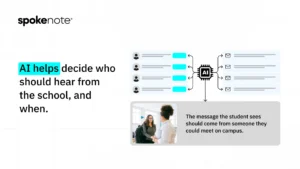
Technology has a real place in this work. AI can help enrollment teams decide who should hear from the school and when. The line worth holding is simple: AI in the back office, a human in the frame.
In practice, that support stays behind the scenes. What the student actually sees, the message itself, should come from a person.
What this looks like in practice
In one engineering school’s admitted-student campaign, every admitted student heard from a person, and dozens signaled deposit intent. That is one school’s experience, not a promise of results for another.
It is also worth being plain about what a personal message does not change. It does not fix open rates or deliverability, and it cannot repair a tired list. What it can change is how the message reads once it is opened, and whether the student believes someone at the school is paying attention.
Frequently asked questions
Is using a student’s first name a bad idea?
No. A first name is fine and often expected. It just does not make a message personal on its own. Pair it with a real sender and a clear reason the message is going to this student.
How short can a personal message be?
Short is fine. Two or three sentences from a named person that mention something specific about the student will pass the test more easily than a long letter that looks like a template, which could have gone to anyone.
What is the quickest way to check our outreach?
Pull the last few messages your admitted students received and run the two questions on each one. If the student cannot tell who sent it, or why it was sent to them, that message is the place to start.