



16 Oct Why Gen Z thinks your polished campus video is a massive red flag
The higher education recruitment landscape is haunted by an expensive ghost: the high-cost, high-production cinematic sizzle reel.
For years, the standard institutional response to declining enrollment was to throw more money at production value. Universities hired agencies to create glossy, carefully controlled versions of campus life, complete with cinematic drone shots, pristine residence halls, scripted student testimonials, and campuses where every blade of grass seems to have received media training.
There is just one problem. Polished does not automatically mean persuasive.
For Gen Z, content that looks too carefully manufactured can create distance instead of trust. What was once intended to signal prestige can now register as advertising before the student has heard a single word. When every smile is perfect, every sentence sounds rehearsed, and every campus moment feels staged for the camera, prospective students have good reason to wonder what they are not seeing.
We call this disconnect the “Uncanny Valley” of admissions. Borrowing from the concept originally introduced by roboticist Masahiro Mori, it describes what happens when something tries so hard to appear human that it starts feeling slightly off. In admissions marketing, that happens when real student experiences are cleaned up, scripted, and polished until very little realness remains.
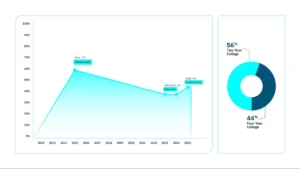
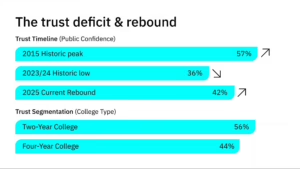
And that matters at a moment when trust in higher education is still recovering. Gallup data shows that public confidence in higher education rebounded to 42% in 2025, up from 36% in 2023 and 2024. That is progress, but confidence remains well below the 57% recorded in 2015.
| Metric | Public Confidence Level |
|---|---|
| 2015 | 57% |
| 2023 | 36% |
| 2024 | 36% |
| 2025 | 42% |
| Two-year colleges, 2025 | 56% |
| Four-year colleges, 2025 | 44% |
Source: Gallup
For enrollment marketers, the takeaway is not that every polished campaign is doomed. It is that prospective students are approaching institutions with more skepticism than they once did. If your marketing looks too perfect, it can feel less like an honest picture of campus life and more like the version admissions wants them to see.
That makes authenticity far more valuable.
Why polished ads are so easy to tune out
The problem with high-production marketing is not simply that Gen Z has different aesthetic preferences. Universities are competing for attention in an environment where students encounter an overwhelming amount of digital content every day, and audiences become very good at recognizing familiar advertising patterns.
A video opens with cinematic music. The drone sweeps over campus. A smiling student walks toward the camera. The lighting is immaculate. Someone says the university “feels like home.”
The viewer already knows what kind of video this is.
Research summarized by Humance illustrates just how dramatically digital attention has changed, with attention spans declining from 150 seconds in 2004 to 47 seconds by 2018. In that environment, repetitive and highly formal content has to fight much harder to earn attention because people naturally learn to tune out patterns they have seen again and again.
Raw video can interrupt that pattern precisely because it does not immediately look like advertising. A student talking into a phone camera from their dorm room, walking between classes, showing what lunch actually looks like, or answering a question without a script feels different from another carefully produced institutional campaign.
The production may be less polished, but the person feels more present. And presence is much harder to scroll past.
Why scripted student videos can feel fake
The original “Uncanny Valley” describes the discomfort people can feel when something appears almost human, but not quite. Admissions marketing can create a similar disconnect when institutions try to manufacture authenticity rather than simply allowing it to happen.
Think about a “Day in the Life” video where the student has clearly memorized every sentence. Or a student ambassador describing campus life using language that sounds suspiciously similar to the university website. The student is technically real, but the interaction does not feel real.
That disconnect matters because prospective students are not only evaluating programs, facilities, rankings, and career opportunities. They are trying to imagine themselves living there. They want to understand the people, the culture, the daily rhythm, and whether they can picture themselves belonging.
Overproduction can unintentionally remove exactly the cues that make that connection possible:
- The awkward pause before someone answers honestly
- The laugh that was not planned
- The dorm room that actually looks lived in
- The student who says something in their own words instead of approved institutional language
- The imperfect camera angle that makes the moment feel spontaneous rather than staged
These details may look insignificant from a production standpoint, but they signal something valuable: there is a real person on the other side of the screen.
If a student cannot relate, they cannot connect. And if they cannot connect, your campaign is toast.
Why Gen Z is gravitating toward lo-fi content
The preference for more relatable content extends well beyond higher education. According to AdWeek, 76% of consumers prioritize authentic, relatable content over polished, high-production branded posts.
That statistic does not mean 76% of students specifically prefer raw phone footage to university sizzle reels. It does, however, reflect a broader shift in what audiences increasingly respond to: content that feels relatable rather than manufactured.
The performance numbers make that shift even harder to ignore.
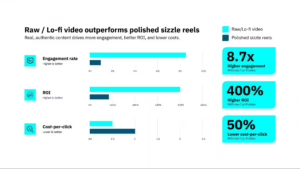
| Metric | Reported UGC Performance |
|---|---|
| Engagement | 8.7x higher than branded content |
| Return on investment | 400% ROI for leading implementations |
| Click-through rate | 4x higher |
| Cost per click | 50% reduction |
| Content creation cost | Up to 70% lower |
These are broader UGC marketing benchmarks, not admissions-specific guarantees. But they reinforce an important point for enrollment teams: spending more on production does not automatically produce better engagement.
That distinction becomes especially important when recruitment budgets are already under pressure. The average cost per inquiry sits at $128 for undergraduate programs and $157 for graduate programs. Every creative dollar therefore needs to do more than make the institution look impressive. It needs to help move a prospective student toward connection, consideration, and ultimately enrollment.
The bottom line is simple. If less expensive student-led content feels more believable and earns more attention, admissions teams have good reason to rethink where production dollars are going. That is also why institutions are increasingly looking beyond media spend alone and considering their Fully Loaded Cost Per Enrollment, including creative costs, technology, and staff time.
Lo-fi is not valuable because it is cheap. It is valuable when lower production friction gives real people more room to show up.
Why “apply today” can miss the moment
Modern recruitment cannot rely entirely on sending the same message to thousands of prospective students and hoping something sticks. The better goal is to make 1,000 prospective students feel as though someone is actually looking them in the eye.
That starts with relevance.
A prospective engineering student may want to hear from an engineering student. A first-generation applicant may have questions that are very different from those of someone whose parents and siblings all attended college. An international student may want to know what arriving on campus really feels like. A student worried about belonging may care less about your newest building than about hearing from someone who once had the same fear.
When prospective students recognize their own questions, ambitions, or anxieties in the person speaking to them, the content stops feeling like general marketing. It begins to feel personally relevant.
That changes the role of the call to action too.
“Apply Today” asks for a transaction. A more human invitation can first help the student imagine themselves inside the experience. That does not mean abandoning practical CTAs. Applications, campus visits, information requests, and deposits still matter. But the emotional connection often needs to happen before the conversion ask.
Some universities are already creating content that works this way:
- Stanford University published an unscripted Instagram Reel showing the aurora borealis over campus. The moment itself carried the content without needing an aggressive recruitment message.
- Syracuse University uses long-form student vlogs, giving prospective students more room to experience everyday campus life through a student’s perspective.
- Louisiana State University has used alumni-submitted visuals, bringing real graduate experiences into institutional storytelling rather than relying solely on the university to narrate the relationship.
None of these examples means production quality has no value. The lesson is simpler: put the human experience ahead of the production.
The AI paradox: efficiency without losing the human part
Generative AI is the next frontier of the Uncanny Valley because Gen Z’s relationship with AI is not as simple as being “for” or “against” it. The same audience can appreciate the convenience and personalization technology provides while becoming uncomfortable when that technology is used to imitate a person.
For example, 81% of Gen Z students appreciate personalized advertising more than previous generations. At the same time, more than 55% of Gen Z consumers disapprove of brands using AI-generated models in advertisements.
The distinction is important. The question for admissions teams is not whether AI belongs in recruitment. It is where AI genuinely improves the experience and where real human presence matters more.
| AI Can Help With | Human Presence Matters Most For |
|---|---|
| Answering routine questions | Sharing lived student experiences |
| Helping students find deadlines | Talking honestly about belonging |
| Organizing credit-transfer information | Providing reassurance during emotional decisions |
| Reducing repetitive administrative friction | Building genuine student-to-student connection |
Technology can remove friction. It can help institutions respond faster, organize information more effectively, and personalize communication more intelligently. Those are meaningful benefits.
But there is a difference between using technology to support a human connection and using it to simulate one.
When the moment calls for empathy, reassurance, humor, vulnerability, personality, or belonging, a real face and a real voice still carry something synthetic communication cannot reproduce. The strongest strategy is therefore not “AI versus authenticity.” It is technology handling what technology does well so real people have more opportunities to handle what people do best.
The era of the perfect university brochure is fading
The Uncanny Valley of Admissions reflects a much bigger cultural shift. For today’s prospective student, the perfect university exists in brochures. The real university is found in the moments that do not look as though they were planned three months in advance.
It is the laugh that stays in the edit. The dorm room that actually looks lived in. The student answering a question in their own words. The professor speaking without a teleprompter. The campus moment captured because someone genuinely wanted to share it, not because it appeared on a creative team’s shot list.
None of this means universities should deliberately make bad content. Good lighting, clear audio, thoughtful storytelling, and strong creative direction still matter. Production value becomes a problem only when it sanitizes the experience so completely that students can no longer recognize themselves inside it.
The institutions that earn trust will be the ones willing to show more of the real experience. They will stop shouting at the masses and start listening to individuals. They will use technology to make communication easier without asking it to replace the people prospective students actually want to hear from.
So before producing the next cinematic campus video, ask a simpler question:
Does this make a prospective student feel impressed, or does it make them feel seen?
Because sometimes the most effective recruitment content is not the most polished video in your library. It is a real student, speaking in their own voice, looking into the camera and giving someone on the other side a reason to think: I can see myself here.
FAQs about Gen Z and higher education video marketing
Why doesn’t Gen Z trust polished campus videos?
Highly produced videos often look like advertising before anyone says a word. When every shot is perfect and every line sounds rehearsed, prospective students start to wonder what they are not seeing. Real, unscripted moments feel more honest and are easier to trust.
What is lo-fi video in admissions marketing?
Lo-fi video is simple, low-production content, usually filmed on a phone by real students or staff. Think a dorm room tour, a walk between classes, or an honest answer to a common question. It works because it feels like a real person talking, not a campaign.
Does this mean universities should stop investing in high-quality video?
No. Good lighting, clear audio and thoughtful storytelling still matter. The problem starts when production removes everything that feels real. The goal is to put the human experience ahead of the production, not to make bad content on purpose.
How can admissions teams make video outreach feel personal at scale?
Match the voice to the student. An engineering applicant wants to hear from an engineering student, and a first-generation applicant may have very different questions than a student whose family all went to college. Personalized video lets teams record once and still deliver a message that feels made for each student.
Should admissions teams use AI-generated video to reach Gen Z?
Use AI where it removes friction, like answering routine questions or finding deadlines. Keep real people for the moments that need trust, such as talking about belonging or helping a student through a big decision. Gen Z welcomes personalization, but many dislike brands using AI to imitate a person.
How do you know if more authentic video is working?
Track what matters to enrollment, not just views. Compare watch rates, replies, campus visit sign-ups, applications and deposits between your polished and student-led content. The best signal is whether students move to the next step after watching.