


07 Apr Why Your Outreach Gets Ignored: The Ad Blindness Crisis and How to Break Through
You spent an hour crafting that cold email. You tested three subject lines. You personalized the opening. You sent it at 9 a.m. on a Tuesday because the blog post said that’s when people check their inbox.
Nobody replied. Most people didn’t even open it.
This is not a unique experience. The average cold email reply rate in 2025 sits at 3.43%. Nineteen out of twenty cold emails get no response at all. Open rates across email marketing dropped from 38.2% in 2023 to 35.6% in 2024, and the decline is consistent: every month of 2024 performed worse than the same month the year before.
If you think better copywriting is the answer, you’re solving the wrong problem. The issue isn’t your message. It’s that no one is actually seeing it.
Your Brain Was Designed to Ignore You
The average person in 2025 is exposed to somewhere between 6,000 and 10,000 ads per day, a figure that has risen from roughly 1,600 in the 1970s and 5,000 in 2007, tracking almost perfectly with the explosion of digital channels. Nobody processes 10,000 ads. The human brain could not function if it did.
So it doesn’t.
The brain’s selective attention system acts as a filter, automatically prioritizing stimuli that matter (unexpected sounds, movement, faces, personal names) and suppressing everything else into the perceptual background. This isn’t a conscious decision. It’s a neurological process, associated with activity in the prefrontal cortex and parietal lobe, and it runs constantly and mostly invisibly.
Banner blindness is what happens when this filter learns to recognize the visual patterns of digital advertising and treat them as background noise. Research by Infolinks found that 86% of consumers experience banner blindness. Nielsen put it at 67% who admit to completely ignoring ads. The average click-through rate on a banner ad is 0.06%. Less than 14% of users even notice most banner ads.
This isn’t cynicism about advertising. It’s selective attention in action. The brain has been trained by years of ad exposure to recognize the shape, position, and texture of commercial content and route it around conscious awareness before it registers.
The mechanism was named for banner ads but it long ago expanded beyond them. Your email outreach, your LinkedIn messages, your paid social, your direct mail, your retargeting: if any of these trigger the brain’s learned pattern for “commercial content I did not ask for,” they get filtered. Not blocked. Ignored. There’s a difference. Blocked means someone thought about it. Ignored means it never made it to thought at all.
Email Isn’t Broken. It’s Invisible.
Email was once a personal channel. When your boss emailed you, when a friend emailed you, when someone emailed you because they specifically wanted to talk to you. Email was signal. That’s why it worked so well for marketers for so long. It piggybacked on a channel the brain treated as interpersonal and therefore important.
That era is over.
There are now 376 billion emails sent and received every day worldwide. The average person receives 121 emails per day. The inbox is no longer a personal communication channel. It is a second social media feed, and the brain has adapted to treat it accordingly. Marketing emails, cold outreach, newsletters, promotional sequences: they’ve trained people’s attention filters to recognize the format and skip it.
The result is a multi-year decline that is accelerating. Cold email response rates have fallen from 8.5% in 2019 to 5% in 2025 – a decline we break down fully in why B2B sales teams are losing the inbox war. The 2024 year-over-year drop was approximately 15%. About 17% of cold outreach emails never reach an inbox at all, lost to spam filters and authentication failures, a problem made worse when Google and Yahoo tightened bulk sender requirements in February 2024.
Even emails that do reach the inbox face an attention filter trained by years of irrelevant commercial messages. Open rates are declining, click rates are declining, and response rates are in freefall. None of this is because your emails are worse than emails from five years ago. It’s because the channel itself has been categorized by the human brain as a source of commercial noise.
The Ad Fatigue Economy
What happened to email happened first to display advertising, and is now happening to every digital channel marketers have colonized.
In 2024, ad blocker usage cost North American publishers and advertisers $24 billion in lost revenue. Among people who use ad blockers, 62.9% cite “too many ads” as the reason they installed one. That’s not a complaint about ad quality. It’s evidence of a coping mechanism. People are building technological walls against commercial interruption because their psychological walls aren’t enough.
And for the ads that do get through? The recall numbers are grim. Forty-one percent of survey respondents can only remember 1-10% of the ads they encountered in a given day. Billions of ad impressions are being served to eyeballs that are physically present but cognitively absent.
The ad fatigue problem is not a temporary blip in the attention economy. It is the logical endpoint of every marketer simultaneously scaling up the same channels. Each additional ad poured into the system trains the audience’s brain to filter harder. Every high-volume cold email sequence that goes out makes the next campaign marginally less effective. The channels didn’t fail because they were bad. They failed because everyone used them the same way until the audience stopped noticing.
The Pattern Interrupt: What the Brain Can’t Automate Away
The attention filter is selective. It blocks what it has learned to recognize as irrelevant commercial signals.
What it hasn’t learned to ignore (because evolution didn’t give it a reason to) is a real human face, a personal address by name, and a message that signals “this is specifically for you and not for anyone else.”
The brain’s face-detection system is ancient and hardwired. It operates before conscious thought, activates instantly on human faces, and triggers social attention circuits that the commercial-content filter doesn’t intercept. A real person looking at you from a screen, saying your name, activates a completely different processing pathway than a subject line in an inbox.
This is where the data gets interesting. Sales teams using personalized video outreach report reply rates of 25-30%, compared to 3-5% for text-only cold email. That’s a 6-9x difference. Click-through rates run 300% higher. Message retention is 95% with video versus 10% with text. On LinkedIn, personalized video direct messages achieve reply rates above 22%.
The performance gap isn’t because video is a novelty. It’s because personalized video doesn’t trigger the filter. A real person recording a short video specifically for you looks like interpersonal communication. Because it is. The brain doesn’t route it into the “irrelevant commercial content” queue.
Companies that have shifted their outreach mix toward personalized video are seeing the results. Brikl achieved a 6x response rate improvement. Hipersa cut sales cycle time by 40%. These aren’t marginal improvements on existing metrics. They’re the kind of step-change that happens when you move from a channel the audience has learned to ignore to one that their brain hasn’t been trained to filter.
What This Means for Your Outreach Strategy
The ad blindness crisis is real, and the trend lines point in one direction. Email and digital ads aren’t going to recover their former effectiveness. The audience’s attention filters are too well-trained and the channels too saturated. Sending more email, running more retargeting, and testing more subject lines will generate diminishing returns on what is already a low base.
The strategic question isn’t “how do I optimize within the channels that are failing.” It’s “how do I communicate in a way the attention filter doesn’t recognize as noise?”
The answer is specificity and human presence. Outreach that is genuinely specific to one person — not data-insertion masquerading as personalization — delivered by a real human face, reads to the brain as a signal rather than noise. That’s not a marketing trick. It’s how interpersonal communication has always worked. The challenge is doing it at scale without losing the qualities that make it work.
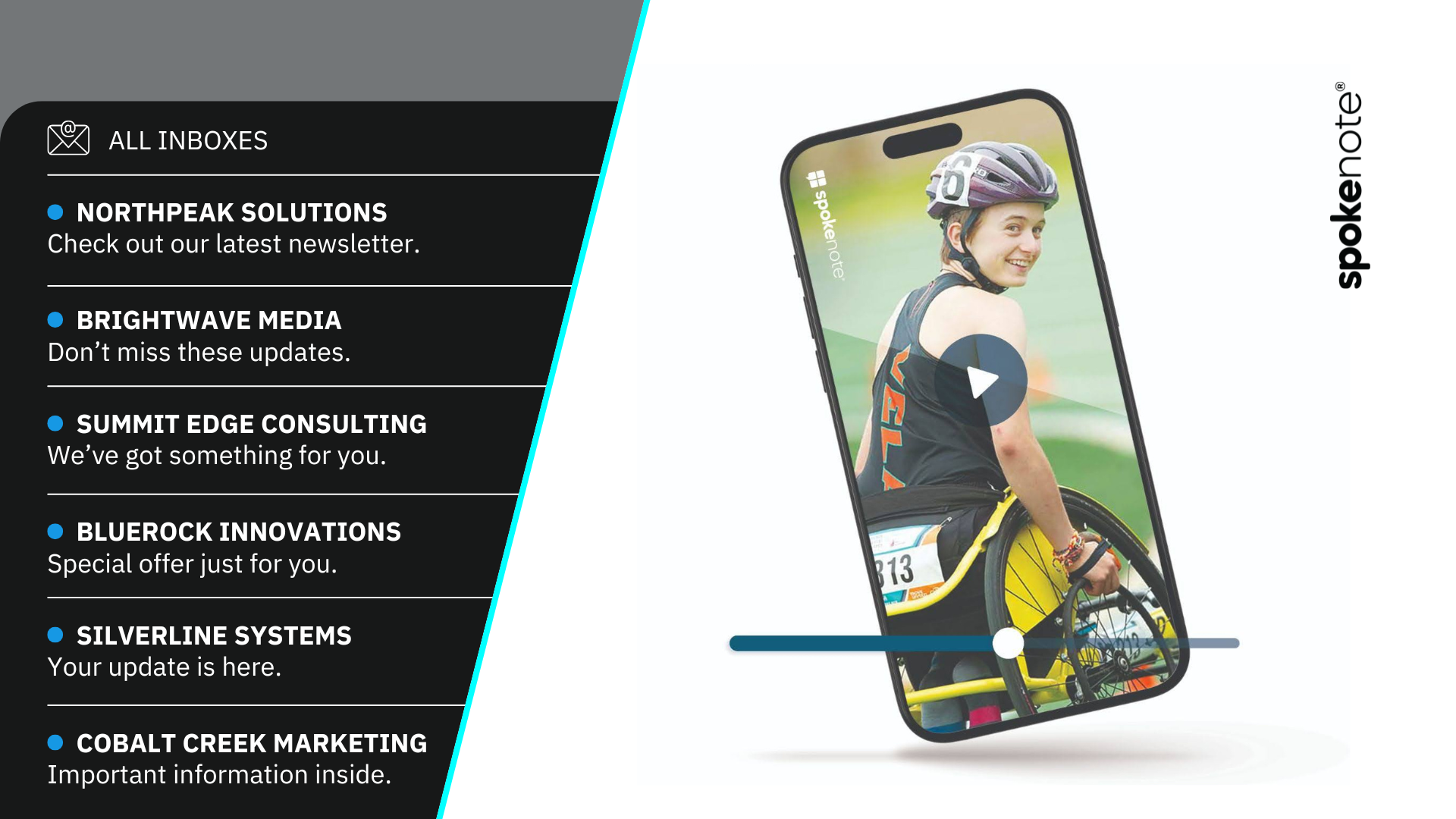
That’s the problem platforms like Spokenote are built to solve. One recorded message, personalized to every recipient, delivered in the register the brain actually pays attention to. If your current outreach numbers look anything like the averages above, it’s worth understanding how personalized video works and what it does differently.
The attention economy is not going to get easier. The question is whether your outreach looks like the noise everyone else is making, or like the thing that still cuts through.