


18 Mar Workflow Support: The Last Thing You Need Is Another Tool You Don’t Use
This is the third and final post in our series on the Keys to Success with Spokenote. If you missed them, start with Key #1: Audience Segmentation and Key #2: Coherent Video Strategy.
Somewhere right now, a marketing director is explaining to their VP why the tool they championed six months ago is still “in the pilot phase.”
Meanwhile, the invoice keeps clearing.
Be honest. How many tools are in your martech stack right now that someone is paying for but nobody is really using? SaaS has a way of becoming Software as another Shelfware – and the graveyard of good ideas is really just an IT department’s billing history.
Tools don’t fail because they’re wrong. They fail because they don’t fit the workflow. Friction is the silent killer of good innovation – and the road to the shelfware graveyard is paved with demos that looked incredible and implementations that didn’t survive first contact with reality.
The number one question we hear when talking with admissions teams, development officers, and marketing directors isn’t “Does this work?” They can see that it works. The question is: “How much more work is this going to create for me? And my team of one. And our part-time intern. Who could forget the intern.”
It’s the right question. And for once, the answer is actually good news.
Why Marketing Tools Fail (It’s Not What You Think)
The failure mode for most martech isn’t bad technology. It’s bad fit.
Tools fail adoption when they’re too complex to learn without a certification, when they don’t play nicely with the systems teams already live in, and when they quietly add hours of manual work to an already-stretched operation. They fail when the cost of using them – in time, in cognitive load, in change management – outweighs the benefit.
“It sounds great in theory” is the kindest thing you can say about a tool that never made it past the pilot.
Spokenote was built with this failure mode in mind. The platform philosophy is simple: snap in, snap out. We are not asking you to rebuild your stack. We’re not replacing your CRM, your email platform, or your direct mail workflow. We’re an ingredient – one that makes everything you’re already doing more effective.
Whether your operation runs on a sophisticated CRM like Salesforce or HubSpot, a marketing automation platform, or honestly, a well-organized spreadsheet – Spokenote works where you work. The CSV remains the lingua franca of data exchange, and it is our friend. It is the Rosetta Stone that bridges even the most disparate systems, with zero drama.
90% Preparation, 10% Execution
Here’s the reframe that changes everything: Spokenote doesn’t add work to your campaigns. It shifts where the work happens.
The effort moves from execution to preparation. You do the thinking up front – you define your audience segments, record your modular video clips, and make the strategic decisions about which message goes to whom. Then the platform handles the rest: assembling thousands of unique, personalized video pages in minutes, not weeks.
Preparation: You know your audience. You’ve done the segmentation work. You’ve recorded the modules – the human intro, the cohort-specific middle, the social proof close. (If you haven’t done this yet, go back and read Key #2. We’ll be right here.)
Execution: Spokenote’s engine stitches it together. One upload. Thousands of unique URLs. Each one a personalized experience built for the person who receives it.
This is the 90/10 principle in practice. Most tools invert it – they promise easy setup and then punish you at the execution stage. Spokenote front-loads the investment so that the moment of delivery is nearly effortless.
Where Spokenote Lives in Your Stack
It helps to know where we fit.
The martech landscape has three primary categories that matter here: Content Marketing Platforms (CMPs) that manage the creation and distribution of content, Multichannel Marketing Hubs (MMHs) that orchestrate journeys across email, SMS, and push, and Personalization Engines (PEs) that use data to tailor experiences. Each does its job well.
If your eyes glazed over reading that paragraph, you’re exactly who we built this for.
Here’s the catch: none of them close the trust gap. CMPs treat video as a static asset to be distributed. MMHs are powerful at scale but struggle at the “last mile” – the moment where a recipient actually feels something. Personalization Engines can segment with precision but often produce the mechanical, name-in-a-template personalization that 53% of customers now recognize and resent.
Spokenote sits in the space between all three – not as a replacement, but as the piece that makes them matter. Think of it as the layer where your data becomes a human moment. Your CRM holds the intelligence. Spokenote delivers the connection.
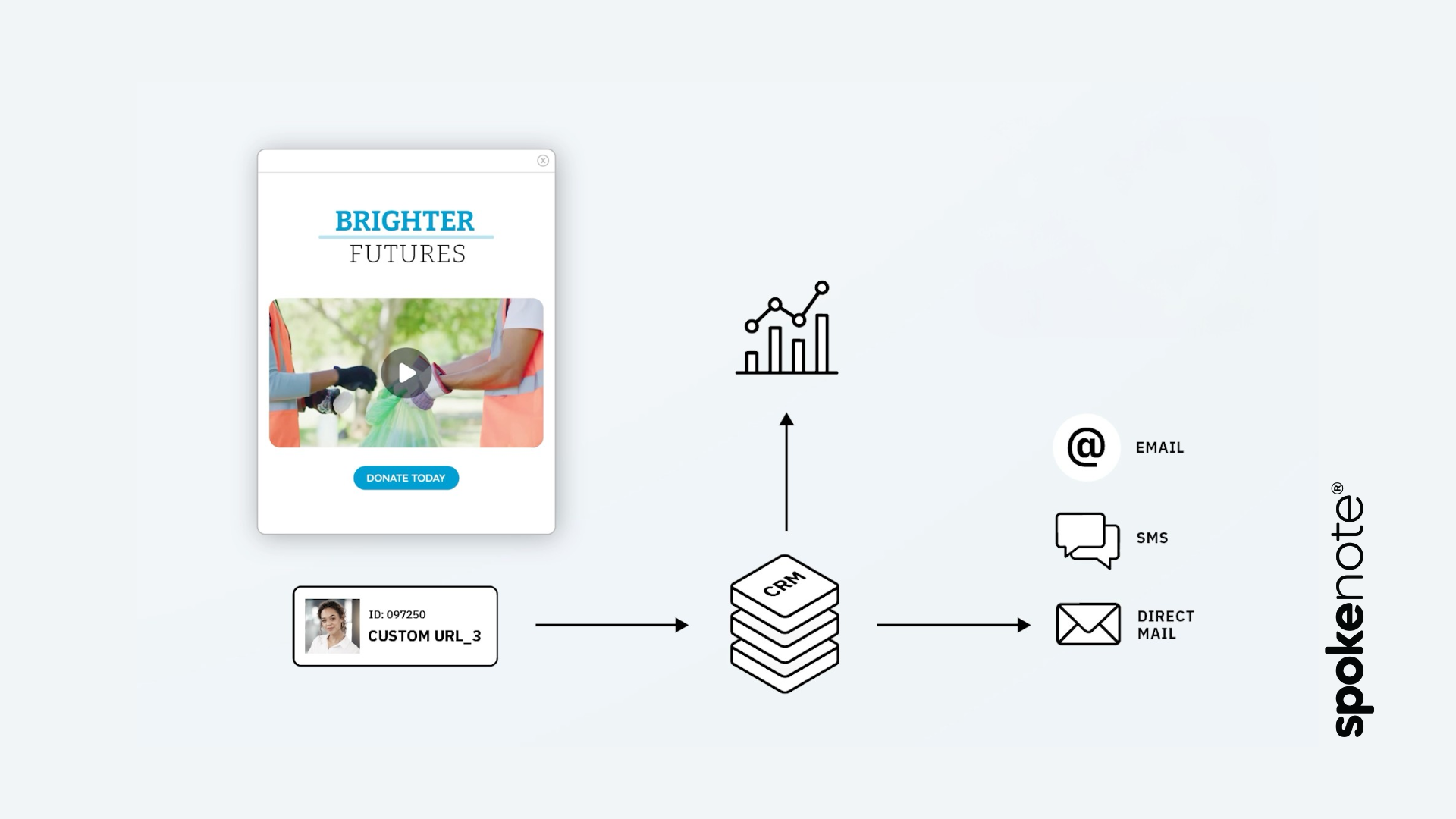
The workflow looks like this: your team uploads your segmented audience, maps the right video modules to the right cohorts, and Spokenote generates thousands of unique, personalized URLs in minutes. Those URLs go back into your CRM or get exported for delivery via email, SMS, or print. Your team makes the decisions. The platform handles the assembly. Revolutionary concept, we know. The goal, over time, is for that process to live more and more inside the systems you already use – but even today, what used to take weeks of production takes an afternoon of preparation.
That’s not adding work. That’s replacing work you’re already doing – with more efficiency and a lot more impact.
The Physical-Digital Bridge (Our Origin. And Still a Secret Weapon.)
Before we were a dynamic video platform, our mantra was “add video to anything” – via a QR code. That’s not a knock – it’s our origin story. We invented it. Spokenote was born from a simple, human idea: link a video to a physical object so that the person holding it could experience something personal the moment they opened it. A care package. A birthday card. A moment that mattered.
That idea was good enough to power the first scannable jersey patch in NBA history – a partnership with the Indiana Pacers that earned recognition for innovation and turned a single game-night moment into a year-round engagement story. Yeah, that was us. Game 7 was a heartbreaker – but we digress.
But here’s the thing about a good foundation: you build on it.
The QR code is still very much part of what we do, and it remains one of the most powerful tools in the workflow – because it bridges the physical and digital worlds in a way no email can replicate. Here’s the paradox of our moment: digital saturation has made physical mail valuable again. Research shows that 65% of consumers prefer physical letters for important communications, and 63% say they’re more likely to act when a message arrives via mail. For Millennials and Gen Z – supposedly the most digital generations – 53% say physical mail feels more personal, and 56% say they feel valued when something arrives in their mailbox.
A scannable code on a physical piece does something an inbox can’t: it earns trust before the video even plays. The act of holding something, of choosing to scan, creates a different kind of attention. Add a personalized video on the other side of that scan – one that speaks directly to who they are and what they care about – and you’ve engineered a moment that digital-only campaigns simply can’t replicate.
Purdue University attributed $4 million in future tuition to Spokenote. Villanova School of Business saw an 85% open rate and 50%+ click-through on an admitted student campaign. GLASA hit their annual donation goal in a single campaign. These aren’t flukes – they’re what happens when the right message reaches the right person through the right channel, without friction.
The Viewer Has to Show Up, Too
Workflow support isn’t just about your team. It’s about the person on the other end.
If your recipient has to download an app, create an account, or navigate three screens before they can watch your message – you’ve already lost them. The decision to engage happens in the first three seconds. Spokenote delivers in a friction-free browser environment: no login, no app, immediate playback, fully mobile-optimized.
But there’s something else worth saying here, something that gets overlooked in the conversation about video delivery: when you send someone to YouTube or post to social, you’re not just sharing your message. You’re handing your audience to someone else’s platform. You spent weeks crafting the perfect message, and YouTube’s algorithm rewarded you with a pre-roll ad for your competitor. Neat. The algorithm decides what plays next. A notification pulls them away mid-sentence. You fought to earn their attention, and then you gave it away.
Spokenote is your channel. Your audience, your voice, your story – in a branded environment where the only thing they can do is watch, feel, and act. No ads. No competing content. No next-video rabbit hole. Just your message, and a clear path to yes.
That’s not a small thing. That’s the entire point.
The Adoption Payoff
When workflow support is done right, something shifts.
Teams actually use the tool – not just in the pilot, but six months later, in the middle of a busy yield season or a year-end giving push. Campaigns don’t stall waiting on production or IT or approvals that never seem to come. Personalization stops being a one-time initiative and becomes a repeatable, scalable part of how you operate.
And trust compounds. Not just with your audience – though that too. Trust compounds internally, because the team that ran one successful dynamic video campaign knows exactly how to run the next one. The 90% preparation gets faster. The 10% execution becomes habit.
The goal was never to be the most interesting line item in your budget. It was to be the one nobody wants to cancel.
This is the last of the three keys, and it might be the most important one – because authenticity without adoption is a great idea on a shelf.
Authentic Interactions in Three Acts
Audience Segmentation ensures you’re relevant. Coherent Video Strategy ensures you’re authentic. Workflow Support ensures you’re consistent.
When all three are in place, you stop sending files and start building relationships. You stop broadcasting and start connecting. You make “Yes” inevitable – not through pressure, but through presence.
The question was never whether personalized human video works. It does. The question was always whether you could make it work for your team, in your workflow, at your scale.
Now you can.
Ready to see how Spokenote fits into your workflow? Let’s talk.