



09 Oct Why lapsed donors disappear, and what actually brings them back
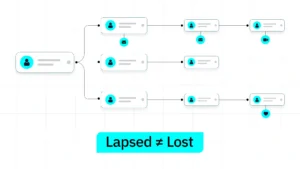 Most lapsed donors did not wake up one morning and decide they were done with your organization. Some lost touch with the mission. Some stopped trusting where their money was going. Some simply could not afford another gift. And some never really “left” at all. Their card expired, a recurring payment failed, and the relationship quietly disappeared into a spreadsheet.
Yet when retention slips, the response is often the same: send another campaign. Your board wants “more engagement.” Everyone in the room knows that eventually means more giving. So another year-end appeal gets built, another email goes out, and another message lands in the same crowded inbox alongside every other nonprofit asking for attention at exactly the same time. Meanwhile, the bigger problem may be sitting in your existing donor file.
According to the Fundraising Effectiveness Project, only 18.9% of first-time donors make a second gift. Roughly four out of five people who trusted an organization enough to give once do not immediately become repeat donors. That makes donor retention less of a follow-up problem and more of a relationship problem.
So, surely, the answer is to win back your lapsed donors? Not quite. Depending on which benchmark you read, reported lapsed-donor reactivation rates range from around 0.8% to as high as 40%, with some sources reporting rates of 20% to 40% for recently lapsed donors. That is not a useful “industry average.” It is a warning that the category itself is hiding too much.
A donor whose payment failed last month is not the same as someone who has been gone for four years. A six-time donor is not the same as a one-time giver. And someone who still cares but lost touch with your updates should not receive the same “We miss you” message as someone who deliberately stepped away.
That is the real story behind the wildly different benchmarks. Before you send another reactivation campaign, the better questions are: Who actually lapsed? How long have they been gone? Why did the relationship stop? And what would make the next message feel relevant rather than automated?
Because the fastest way to waste a reactivation campaign is to treat every lapsed donor like the same donor.
Before you reactivate anyone, define what “lapsed” means
“Lapsed donor” sounds like a neat category. In practice, it covers very different people. One donor may have deliberately stopped supporting your organization. Another may still care deeply but missed your last few appeals. A monthly donor may simply have an expired credit card sitting between them and their next gift.
There is no single sector-wide definition of a lapsed donor. Some organizations work with a 12-month window, while others use 18 months or as much as 12 to 24 months depending on their giving cycle. Fundraisers also commonly distinguish between LYBUNT donors, meaning “last year but unfortunately not this year,” and SYBUNT donors, meaning “some year but unfortunately not this year.” Those distinctions help teams understand how recently the relationship went quiet.
That matters because a donor who gave recently needs a very different conversation from someone whose last gift arrived years ago. Recurring donors deserve their own check too. A failed recurring gift may have nothing to do with declining loyalty. The card expired, the payment failed, and nobody fixed it. Before launching a carefully crafted reactivation campaign, run the billing report.
Sometimes donor retention is emotional. Sometimes it is plumbing.
Before you send anything, split the list
Before drafting a reactivation email, split your lapsed donor list into groups that actually tell you something useful. You do not necessarily need new software to begin. For a lean development team, this can start with a spreadsheet, a few clean filters, and an hour of focused work.
At minimum, segment by:
- Lapse duration: recently lapsed versus donors who have been gone for two years or more
- Giving history: LYBUNT versus SYBUNT
- Reason for lapse: failed billing versus genuine disengagement
- Relationship depth: one-time donor versus someone with multiple previous gifts
- Giving pattern: recurring, annual, campaign-specific, mid-level, or another meaningful cohort
The important part is what happens next: the segment should change the message. A failed-card donor may need a practical reminder. A recently lapsed supporter may need an impact update. Someone who has not heard from you meaningfully in years probably should not receive an email that begins, “We miss you!” as though you spoke last Tuesday.
Segmentation makes the outreach match the actual relationship. That sounds obvious, but it is exactly what gets lost when every lapsed donor is dropped into one reactivation campaign.
Why lapsed donor benchmarks are all over the place
Ask for a standard lapsed donor reactivation rate, and you will quickly discover that “standard” is doing a lot of work. Different sources report dramatically different results, often because they are measuring different donor populations, lapse periods, and fundraising programs.
| Source/benchmark | Reported reactivation rate | Context |
|---|---|---|
| 4aGoodCause | About 0.8% | General lapsed-donor benchmark cited by source |
| Dataro | About 4% to 9.8% | Reactivation figures discussed across donor-retention data |
| ReportingXpress | 8% to 12% | Donors lapsed for less than two years |
| Bloomerang / Roger Craver research | 20% to 40% | Recently lapsed donors |
| Bloomerang customer data | About 2.2% | Donors gone for roughly two years |
The point is not to decide which number is “correct.” A recently lapsed recurring donor and a one-time donor from four years ago may both be called lapsed, but expecting them to reactivate at the same rate makes little sense.
The useful pattern is simpler: recency matters. The longer the relationship has been inactive, the harder reactivation generally becomes. That is why lapse duration belongs near the top of your segmentation process rather than buried somewhere in the CRM.
Compare that uncertainty with first-time donor retention, where the numbers are much more consistent. Fundraising Effectiveness Project data places overall donor retention around 42.9% to 43.3%, while first-time donor retention sits near 19.4%. That makes the second gift one of the most important moments in the donor relationship and suggests something development teams should not overlook: the strongest lapsed-donor strategy may begin before the donor ever lapses.
Your thank-you may matter more than your next campaign
You know the thank-you letter that goes out weeks after the donation because it was waiting behind three appeals, a gala invitation, and seventeen other things? That delay may be costing more than it appears.
Research cited by DonorPerfect reports first-time donor retention at roughly 18%, rising to 38% among donors receiving a handwritten thank-you. Neon One also cites Penelope Burk’s research showing that board-member thank-you calls within 24 hours produced a 39% increase in future donor involvement. Another fundraising source reports that donors are roughly four times more likely to give again when thanked within 48 hours.
Those figures come from different studies and should not be blended into one universal benchmark. But they point in the same direction: fast, human acknowledgment matters. A donor should not have to wait several weeks to learn whether anyone noticed their gift, and improving that experience does not necessarily require a bigger production budget. It requires speed, a real person, and a decision to stop treating the thank-you as administrative cleanup after the “real” fundraising work is done.
The second ask has a clock on it
The first gift should not disappear into your database until the next annual appeal. Research around second-gift timing suggests there is a meaningful period when the relationship is still warm, and the donor still remembers why they acted.
RKD Group recommends working toward a second gift within roughly 60 days and reports that donors who make that second contribution are three times more likely to renew the following year. Neon One approaches the same issue from the other direction, warning that waiting beyond 90 days can sharply reduce the likelihood of securing that second gift.
The exact day will vary by donor, campaign, and organization, so there is no need to pretend day 60 contains some kind of fundraising magic. The operational lesson is what matters:
- Thank the donor quickly.
- Show them what happened because they gave.
- Keep the relationship visible between transactions.
- Make the next relevant invitation while the first decision still means something.
A donor should not have to rediscover your organization every time you ask them to give.
Personalization helps. Gratitude alone does not.
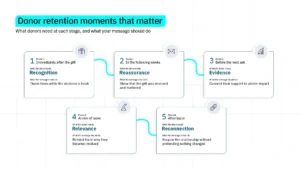 Fundraisers already know they should personalize thank-you messages. The problem is assuming the thank-you completes the relationship.
Bloomerang’s Mission Retainable research found that 97% of fundraisers report sending personalized thank-you notes, while 65% of donors say ongoing impact updates help them feel genuinely connected. If nearly everyone is already saying thank you, then adding a first name to another message is clearly not enough on its own to solve donor retention.
Donors also need evidence that the relationship continued after the transaction. They need to know their gift was noticed, understand what happened because they gave, and hear from you before the next message arrives asking for more.
Gratitude is necessary, but it works best as the beginning of stewardship rather than the end of it. Follow-through is what gives gratitude somewhere to go.
Why donors stop giving is less dramatic than you think
When a donor disappears, it is tempting to assume something went wrong. Maybe they were disappointed. Maybe they lost faith in the organization. Maybe another nonprofit won them over. Sometimes those things happen, but the data paints a less dramatic picture.
Neon One surveyed 2,006 donors and found that 11.6% had stopped giving to an organization they previously supported during the prior year. When those donors were asked why, affordability was the biggest reason.
| Reason for stopping support | Share of respondents |
|---|---|
| Could no longer afford to give | 42.9% |
| No longer felt connected to the mission | 22.7% |
| Did not trust how the money was being used | 15.5% |
You cannot solve the first problem with better copy. If someone cannot afford to give, respect that. The other two reasons, however, sit much closer to the work development teams can influence. Connection and trust matter on both sides of the relationship, and among donors who continued giving, 66.2% cited feeling connected to the mission.
People often stop giving when connection weakens and keep giving when it remains strong. So before asking, “How do we get this donor back?” ask something slightly more uncomfortable: What have we given them to stay connected to between asks?
Relationship depth may matter more than the last check
A large final gift is easy to notice, but it may not tell you as much about reactivation potential as the history behind it.
Dataro’s modeling of donor behavior identifies factors such as the number of previous gifts, previous upgrades, and total lifetime giving as important predictors of reactivation. Average previous gift size was less influential in that modeling. Because the analysis is vendor-generated rather than peer-reviewed research, it is best treated as directional.
Still, the practical takeaway is useful. A donor who gave several times modestly may have a deeper relationship with your organization than someone who made one larger gift and disappeared. Do not let the amount on the last check become the entire relationship story. Look at how often the donor showed up, how long they stayed, what they supported, and whether the relationship grew over time.
Where AI helps, and where the human still has to show up
AI can help a development team sort through thousands of donor records, identify patterns, and prioritize which people appear most at risk of lapsing or most likely to respond. For a small team staring at a giant CRM, that can be genuinely useful. What technology should not do is turn the donor relationship into another synthetic interaction.
Dataro has published case data describing a nonprofit that retained 64 at-risk donors in one month after using predictive scoring, representing an estimated $23,040 in recovered giving. Because that result comes from a vendor-associated case example rather than an independent audit, it should be treated as directional rather than universal.
The more useful distinction is between what technology can help identify and what still needs to feel unmistakably human:
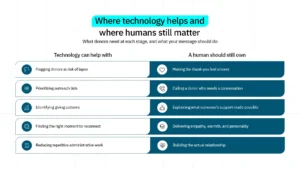 The goal is not “AI versus human.” It is using technology to help a small development team spend more of its limited time on the people who most need a human response. That is a much better use of automation than asking it to imitate one.
What human connection at scale can actually look like
None of this is particularly useful if the recommendation is simply, “Do more one-to-one outreach.” Most development teams already have more relationship work than people available to do it. The real challenge is identifying the moments where human presence matters most and finding a practical way to show up there without multiplying the team’s workload.
Imagine a lean development team creating a small set of donor videos: one welcoming first-time donors, one reconnecting with carefully segmented lapsed donors, and one giving existing donors an impact update before an important campaign or year-end ask. The team does not need to record hundreds of separate videos. The goal is to create genuine human messages that can be personalized for the right donor or cohort without turning the process into another full-time job.
That approach fits what the research throughout this article keeps pointing toward: speed, relevance, visible impact, and sustained human presence.
Spokenote’s own customer examples show what this mechanism can look like at scale, although they should not be mistaken for independent research specifically on lapsed-donor reactivation. In a Purdue campaign, personalized video outreach produced a 53% video interaction rate and more than $4 million in estimated tuition revenue. GLASA, a nonprofit serving athletes with physical and visual disabilities, saw a 173% engagement lift using personalized video outreach.
Those are Spokenote customer outcomes, not sector-wide lapsed-donor benchmarks, and that distinction matters. The evidence for personalized video specifically reactivating lapsed donors is still thinner than the evidence supporting the broader principles underneath it: people respond to relevance, human acknowledgment, visible impact, and communication that feels like it was meant for them.
The technology’s role is to make those human moments easier to deliver at scale without removing the person from them.
Three donor moments lean teams should protect
Nobody is asking a development director to record a personal video after every gift. Instead, focus the human effort on the moments where it has the best chance of strengthening the relationship:
- The first-time donor thank-you. Respond quickly while the donor still remembers why they acted. Make the acknowledgment feel like the beginning of a relationship, not the receipt for a transaction.
- The lapsed donor reactivation. Segment before reaching out. A failed card, a recently lapsed donor, and someone who has been absent for years should not receive the same message. Let lapse duration, giving history, and likely reason for disengagement shape the tone.
- The pre-ask impact update. Before asking for another gift, show donors what the previous one did. Give them something specific enough to remind them why they supported you in the first place.
Those moments will not solve every donor-retention problem, but they give lean teams a much more useful starting point than “send more engagement.”
The takeaway: stop treating every lapsed donor like the same donor
Lapsed donor reactivation benchmarks are messy because lapsed donors are not one audience. Reported rates range from less than 1% to 40% because the underlying donors, definitions, lapse periods, datasets, and fundraising programs vary too. Building your strategy around one benchmark hides the information that actually matters.
Start with the donor instead:
- How long have they been gone?
- Was the lapse voluntary or simply a billing failure?
- How many times had they given before?
- What did they support?
- Did they receive meaningful follow-up after the gift?
- What would make the next message feel relevant rather than automated?
Then choose the outreach.
The strongest evidence in donor retention keeps pointing back to the same fundamentals: acknowledge people quickly, maintain connection between asks, show impact, and make the communication feel like it came from another human being. Technology can help you find the right people and the right moment, but it should make the human part easier to deliver, not make it disappear.